Mammalia |
Cetartiodactyla |
Balaenidae
สิ่งแวดล้อม : สิ่งแวดล้อม / เขตภูมิอากาศ / ระดับความลึก / ระยะการกระจายสินค้า
นิเวศวิทยา
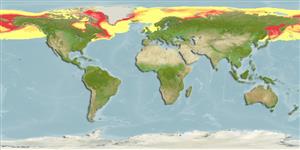
ผิวน้ำ. Polar; 90°N - 0°S, 180°W - 180°E
Pacific Ocean, Northern Atlantic and the Arctic. [Bering-Chukchi-Beaufort Sea population: LR/cd; Okhotsk Sea population: EN, D; Svalbard-Barents Sea (Spitsbergen) population: CR, D: IUCN 2010 (Ref. 84930)].
ความยาวเมื่อครบกำหนดครั้งแรก / ขนาด / น้ำหนัก / อายุ
วัยเจริญพันธุ์: Lm 1,400.0, range 125 - 140 cm Max length : 1,800 cm TL เพศผู้/กระเทย; (อ้างอิง 1394); 2000 cm TL (female); น้ำหนักสูงสุดที่มีการรายงาน: 100.0 t (อ้างอิง 1394)
Lives among the pack ice, migrating to the high arctic summer, but retreating southward in winter with the advancing ice edge. Feeds on small to medium-sized invertebrates, especially krill and copepods. Bowhead whales were heavily hunted for several centuries. Today they are partially protected by the IWC. The current world population is still threatened by small-scale hunting by Alaskan, Canadian, and Russian natives. In addition, there are various forms of habitat degradation, including disturbance from oil and gas exploration and development activities (Ref. 1394). Lives among the pack ice, migrating to the high arctic summer, but retreating southward in winter with the advancing ice edge. Feeds on small to medium-sized invertebrates, especially krill and copepods (Ref. 1394).
วงจรชีวิตและพฤติกรรมการผสมพันธุ์
วัยเจริญพันธุ์ | การสืบพันธุ์ | การวางไข่ | เซลสืบพันธ์ของเพศเมีย(ไข่) | ความดกของไข่ | ตัวอ่อน
Females calve once every 3 to 5 years, i.e., very low reproductive capacity (Ref. 118436).
Jefferson, T.A., S. Leatherwood and M.A. Webber 1993 FAO species Identification Guide: Marine Mammals of the World. Rome, FAO. 320 p. + 587 figures. (อ้างอิง 1394)
สถานะบัญชีแดงของ IUCN
(อ้างอิง 130435: Version 2025-2 (Global))
สถานะไซเตส (อ้างอิง 108899)
CMS (อ้างอิง 116361)
ภัยคุกคามต่อมนุษย์
การใช้ของมนุษย์
การประมง: การค้า
FAO - การประมง: โปรไฟล์สายพันธุ์, landings search; Publication: search | FishSource | ทะเลรอบๆเรา
เครื่องมือ
ข้อมูลเพิ่มเติม
เกี่ยวข้องกับมนุษย์แสตมป์ เหรียญ อื่นๆ
แหล่งที่มาจากอินเตอร์เน็ต
การประมาณค่าตามแบบจำลอง
ความสามารถในการกลับคืนสู่ปกติ
(Ref. 69278): |
ต่ำมาก, เวลาต่ำสุดที่จะทำให้ประชากรเพิ่มขึ้นเป็น 2 เท่าใช้เวลามากกว่า 14 ปี (K=0.03; tm=20) |
ความเสี่ยงต่อการตกปลา
(อ้างอิง 71543) |
Very high vulnerability (88 of 100). |
หมวดหมู่ราคา
(อ้างอิง 80766): |
Unknown. |