Mammalia |
Cetartiodactyla |
Balaenidae
Ambiente: milieu / zona climática / intervalo de profundidade / gama de distribuição
Ecologia
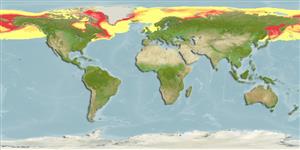
Pelágico(a,os,as). Polar; 90°N - 0°S, 180°W - 180°E
Pacific Ocean, Northern Atlantic and the Arctic. [Bering-Chukchi-Beaufort Sea population: LR/cd; Okhotsk Sea population: EN, D; Svalbard-Barents Sea (Spitsbergen) population: CR, D: IUCN 2010 (Ref. 84930)].
Comprimento na primeira maturidade / Tamanho / Peso / Idade
Maturidade: Lm 1,400.0, range 125 - 140 cm Max length : 1,800 cm TL macho/indeterminado; (Ref. 1394); 2000 cm TL (female); peso máx. Publicado: 100.0 t (Ref. 1394)
Lives among the pack ice, migrating to the high arctic summer, but retreating southward in winter with the advancing ice edge. Feeds on small to medium-sized invertebrates, especially krill and copepods. Bowhead whales were heavily hunted for several centuries. Today they are partially protected by the IWC. The current world population is still threatened by small-scale hunting by Alaskan, Canadian, and Russian natives. In addition, there are various forms of habitat degradation, including disturbance from oil and gas exploration and development activities (Ref. 1394). Lives among the pack ice, migrating to the high arctic summer, but retreating southward in winter with the advancing ice edge. Feeds on small to medium-sized invertebrates, especially krill and copepods (Ref. 1394).
Ciclo de vida e comportamento de acasalamento
Maturidade | Reprodução | Desova | Ovos | Fecundidade | Larvas
Females calve once every 3 to 5 years, i.e., very low reproductive capacity (Ref. 118436).
Jefferson, T.A., S. Leatherwood and M.A. Webber 1993 FAO species Identification Guide: Marine Mammals of the World. Rome, FAO. 320 p. + 587 figures. (Ref. 1394)
Categoria na Lista Vermelha da IUCN
(Ref. 130435: Version 2025-2 (Global))
Categoria CITES (Ref. 108899)
Ameaça para o homem
Utilização humana
Pescarias: espécies comerciais
FAO - pescarias: perfil da espécie, landings search; Publication: search | FishSource | Sea Around Us
Ferramentas
Mais informação
FisiologiaConsumo de oxigénio
Relacionado com o ser humanoSelos, moedas, diversos.
Fontes da internet
Estimativas baseadas em modelos
Resiliência
(Ref. 69278): |
Muito baixo, tempo mínimo de duplicação da população maior que 14 anos (K=0.03; tm=20) |
Vulnerabilidade da pesca
(Ref. 71543) |
Very high vulnerability (88 of 100). |
Categoria de preço
(Ref. 80766): |
Unknown. |