Mammalia |
Cetartiodactyla |
Balaenidae
Ambiente: milieu / zona climatica / distribuzione batimetrica / gamma di distribuzione
Ecologia
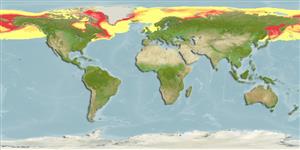
Pelagico. Polar; 90°N - 0°S, 180°W - 180°E
Pacific Ocean, Northern Atlantic and the Arctic. [Bering-Chukchi-Beaufort Sea population: LR/cd; Okhotsk Sea population: EN, D; Svalbard-Barents Sea (Spitsbergen) population: CR, D: IUCN 2010 (Ref. 84930)].
Lunghezza alla prima maturità / Dimensione / Peso / Età
Maturità: Lm 1,400.0, range 125 - 140 cm Max length : 1,800 cm TL maschio/sesso non determinato; (Fonte Biblio. 1394); 2000 cm TL (female); peso massimo pubblicato: 100.0 t (Fonte Biblio. 1394)
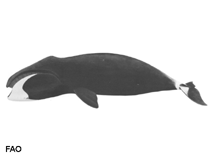
Lives among the pack ice, migrating to the high arctic summer, but retreating southward in winter with the advancing ice edge. Feeds on small to medium-sized invertebrates, especially krill and copepods. Bowhead whales were heavily hunted for several centuries. Today they are partially protected by the IWC. The current world population is still threatened by small-scale hunting by Alaskan, Canadian, and Russian natives. In addition, there are various forms of habitat degradation, including disturbance from oil and gas exploration and development activities (Ref. 1394). Lives among the pack ice, migrating to the high arctic summer, but retreating southward in winter with the advancing ice edge. Feeds on small to medium-sized invertebrates, especially krill and copepods (Ref. 1394).
Ciclo vitale e comportamento di accoppiamento
Maturità | Riproduzione | Deposizione | Uova | Fecondità | Larve
Females calve once every 3 to 5 years, i.e., very low reproductive capacity (Ref. 118436).
Jefferson, T.A., S. Leatherwood and M.A. Webber 1993 FAO species Identification Guide: Marine Mammals of the World. Rome, FAO. 320 p. + 587 figures. (Fonte Biblio. 1394)
Stato della Lista Rossa IUCN
(Fonte Biblio. 130435: Version 2025-2 (Global))
Stato della CITES (Fonte Biblio. 108899)
CMS (Fonte Biblio. 116361)
Minaccia per l'uomo
Usi umani
Pesca: commerciale
FAO - pesca: profilo della specie, landings search; Publication: search | FishSource | Sea Around Us
Strumenti
Informazioni ulteriori
Dinamica della popolazione FisiologiaConsumo di ossigeno
Legato all'uomoFrancobolli, monete, materiale vario.
Fonti Internet
Stime basate su modelli
Resilienza
(Ref. 69278): |
Molto basso, tempo minimo di raddoppiamento della popolazione più di 14 anni (K=0.03; tm=20) |
Vulnerabilità della pesca
(Fonte Biblio. 71543) |
Very high vulnerability (88 of 100). |
Categoria di prezzo
(Fonte Biblio. 80766): |
Unknown. |