Mammalia |
Cetartiodactyla |
Balaenidae
Entorno: milieu / zona climática / rango de profundidad / gama de distribución
Ecología
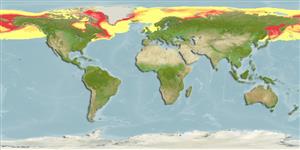
Pelágico. Polar; 90°N - 0°S, 180°W - 180°E
Pacific Ocean, Northern Atlantic and the Arctic. [Bering-Chukchi-Beaufort Sea population: LR/cd; Okhotsk Sea population: EN, D; Svalbard-Barents Sea (Spitsbergen) population: CR, D: IUCN 2010 (Ref. 84930)].
Longitud en la primera madurez / Tamaño / Peso / Edad
Madurez: Lm 1,400.0, range 125 - 140 cm Max length : 1,800 cm TL macho / no sexado; (Referencia 1394); 2000 cm TL (female); peso máximo publicado: 100.0 t (Referencia 1394)
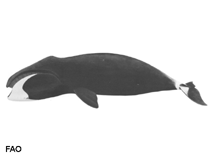
Lives among the pack ice, migrating to the high arctic summer, but retreating southward in winter with the advancing ice edge. Feeds on small to medium-sized invertebrates, especially krill and copepods. Bowhead whales were heavily hunted for several centuries. Today they are partially protected by the IWC. The current world population is still threatened by small-scale hunting by Alaskan, Canadian, and Russian natives. In addition, there are various forms of habitat degradation, including disturbance from oil and gas exploration and development activities (Ref. 1394). Lives among the pack ice, migrating to the high arctic summer, but retreating southward in winter with the advancing ice edge. Feeds on small to medium-sized invertebrates, especially krill and copepods (Ref. 1394).
Ciclo vital y comportamiento de apareamiento
Madurez | Reproducción | Puesta | Huevos | Fecundidad | Larva
Females calve once every 3 to 5 years, i.e., very low reproductive capacity (Ref. 118436).
Jefferson, T.A., S. Leatherwood and M.A. Webber 1993 FAO species Identification Guide: Marine Mammals of the World. Rome, FAO. 320 p. + 587 figures. (Referencia 1394)
Situación en la Lista Roja de la UICN
(Referencia 130435: Version 2025-2 (Global))
Estatus CITES (Referencia 108899)
CMS (Referencia 116361)
Amenaza para el ser humano
Usos humanos
Pesquerías: comercial
FAO - pesquerías: perfil de la especie, landings search; Publication: search | FishSource | Sea Around Us
Herramientas
Más información
FisiologíaConsumo del oxígeno
Relacionados con el ser humanoSellos, monedas, varios
Fuentes de Internet
Estimaciones basadas en modelos
Resiliencia
(Ref. 69278): |
Muy bajo, población duplicada en un tiempo mínimo superior a 14 años (K=0.03; tm=20) |
Vulnerabilidad pesquera
(Referencia 71543) |
Very high vulnerability (88 of 100). |
Categoría de precios
(Referencia 80766): |
Unknown. |