Mammalia |
Cetartiodactyla |
Balaenidae
Lingkungan: lingkungan / zona iklim / kisaran kedalaman / jangkauan distribusi
Ekologi
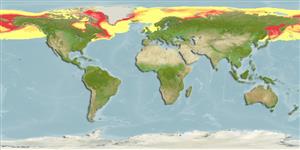
Pelagis, permukaan. Polar; 90°N - 0°S, 180°W - 180°E
Pacific Ocean, Northern Atlantic and the Arctic. [Bering-Chukchi-Beaufort Sea population: LR/cd; Okhotsk Sea population: EN, D; Svalbard-Barents Sea (Spitsbergen) population: CR, D: IUCN 2010 (Ref. 84930)].
Panjang pada saat jatuh tempo pertama / Ukuran / Berat / umur
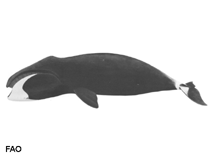
Kematangan: Lm 1,400.0, range 125 - 140 cm Max length : 1,800 cm TL jantan/; (Acuan 1394); 2000 cm TL (female); Berat maksimum terpublikasi: 100.0 t (Acuan 1394)
Lives among the pack ice, migrating to the high arctic summer, but retreating southward in winter with the advancing ice edge. Feeds on small to medium-sized invertebrates, especially krill and copepods. Bowhead whales were heavily hunted for several centuries. Today they are partially protected by the IWC. The current world population is still threatened by small-scale hunting by Alaskan, Canadian, and Russian natives. In addition, there are various forms of habitat degradation, including disturbance from oil and gas exploration and development activities (Ref. 1394). Lives among the pack ice, migrating to the high arctic summer, but retreating southward in winter with the advancing ice edge. Feeds on small to medium-sized invertebrates, especially krill and copepods (Ref. 1394).
Females calve once every 3 to 5 years, i.e., very low reproductive capacity (Ref. 118436).
rujukan utama
Acuan | Koordinator | mitra
Jefferson, T.A., S. Leatherwood and M.A. Webber 1993 FAO species Identification Guide: Marine Mammals of the World. Rome, FAO. 320 p. + 587 figures. (Acuan 1394)
Status IUCN Red List
(Acuan 130435: Version 2025-2 (Global))
status CITES (Acuan 108899)
ancaman kepada manusia
penggunaan manusia
Perikanan: komersial
FAO - Perikanan: profail spesis, landings search; Publication: search | FishSource | Laut di Sekitar Kita
Alat, peralatan
informasi lanjut
FisiologiKonsumsi oksigen
Yang berhubungan dengan manusiaPerangko, koin, dll.
Sumber internet
Estimasi berdasarkan model
Daya lenting
(Ref. 69278): |
sangat rendah, Waktu penggandaan populasi minimum lebih dari 14 tahun (K=0.03; tm=20) |
Kerentanan Penangkapan Ikan
(Acuan 71543) |
Very high vulnerability (88 of 100). |
kategori harga
(Acuan 80766): |
Unknown. |