Mammalia |
Cetartiodactyla |
Balaenidae
Environnement : milieu / zone climatique / profondeur / gamme de distribution
Écologie
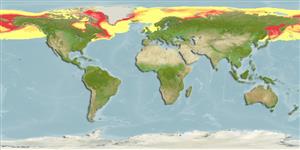
Pélagique. Polar; 90°N - 0°S, 180°W - 180°E
Pacific Ocean, Northern Atlantic and the Arctic. [Bering-Chukchi-Beaufort Sea population: LR/cd; Okhotsk Sea population: EN, D; Svalbard-Barents Sea (Spitsbergen) population: CR, D: IUCN 2010 (Ref. 84930)].
Longueur à la première maturité / Taille / Poids / Âge
Maturité: Lm 1,400.0, range 125 - 140 cm Max length : 1,800 cm TL mâle / non sexé; (Réf. 1394); 2000 cm TL (female); poids max. publié: 100.0 t (Réf. 1394)
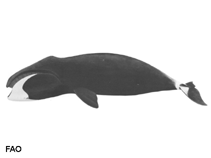
Lives among the pack ice, migrating to the high arctic summer, but retreating southward in winter with the advancing ice edge. Feeds on small to medium-sized invertebrates, especially krill and copepods. Bowhead whales were heavily hunted for several centuries. Today they are partially protected by the IWC. The current world population is still threatened by small-scale hunting by Alaskan, Canadian, and Russian natives. In addition, there are various forms of habitat degradation, including disturbance from oil and gas exploration and development activities (Ref. 1394). Lives among the pack ice, migrating to the high arctic summer, but retreating southward in winter with the advancing ice edge. Feeds on small to medium-sized invertebrates, especially krill and copepods (Ref. 1394).
Cycle de vie et comportement reproducteur
Maturité | Reproduction | Frai | Œufs | Fécondité | Larves
Females calve once every 3 to 5 years, i.e., very low reproductive capacity (Ref. 118436).
Jefferson, T.A., S. Leatherwood and M.A. Webber 1993 FAO species Identification Guide: Marine Mammals of the World. Rome, FAO. 320 p. + 587 figures. (Réf. 1394)
Statut dans la liste rouge de l'IUCN
(Réf. 130435: Version 2025-2 (Global))
statut CITES (Réf. 108899)
Menace pour l'homme
Utilisations par l'homme
Pêcheries: commercial
FAO - pêcheries: Résumé espèce, landings search; Publication: search | FishSource | Sea Around Us
Outils
Plus d'informations
Dynamique des populations PhysiologieConsommation d'oxygène
Liées à l'hommeTimbres, pièces de monnaie, divers
Sources Internet
Estimations basées sur des modèles
Résilience
(Ref. 69278): |
Très faible, temps minimum de doublement de population supérieur à 14 ans (K=0.03; tm=20) |
Vulnérabilité de la pêche
(Réf. 71543) |
Very high vulnerability (88 of 100). |
Catégorie de prix
(Réf. 80766): |
Unknown. |