Bivalvia |
Ostreida |
Ostreidae
Meio ambiente: milieu / Zona climática / intervalo de profundidade / faixa de distribuição
Ecologia
Benthic; estuarina; intervalo de profundidade 0 - 50 m (Ref. 104365). Tropical, preferred 27°C (Ref. 107945); 25°N - 35°S, 96°W - 34°W
Atlantic Ocean: from southern Gulf of Mexico to Uruguay. Introduced in UK.
Comprimento de primeira maturação / Tamanho / Peso / Idade
Maturidade: Lm ? range ? - ? cm Max length : 12.0 cm NG macho/indeterminado; (Ref. 271)
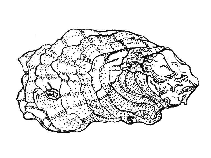
Diagnostic features: Shell lightweight, deep-cupped inequivalve, left valve (attached) larger than right. Shell shape and outline variable. Inner margin smooth. Presidium transversally striated. Colour: externally dirty light grey, internally whitish or light grey splotched with bluish purple (Ref. 271).
It has a total length of 12 cm. Fisheries: It is heavily exploited due to over exploitation or contaminated by organic pollutants. It is consumed raw, fried, grilled or boiled. Canned industrially (Ref. 271). Attached to roots of Rhizophora mangle, rocks or other oyster shells. It is mostly intertidal or shallow-subtidal species (Ref. 271).
Ciclo de vida ou comportamento de acasalamento
Maturidade | Reprodução | Desova | Ovos | Fecundidade | Larvas
Members of the class Bivalvia are mostly gonochoric, some are protandric hermaphrodites. Life cycle: Embryos develop into free-swimming trocophore larvae, succeeded by the bivalve veliger, resembling a miniature clam.
Carpenter, K.E. (ed.) 2002 The living marine resources of the Western Central Atlantic. Volume 1: Introduction, molluscs, crustaceans, hagfishes, sharks, batoid fishes, and chimaeras. FAO Species Identification Guide for Fishery Purposes and American Society of Ichthyologists and Herpetologists Special Publication No. 5, Rome. 600p. (Ref. 271)
Status na Lista Vermelha da UICN
(Ref. 130435: Version 2025-2 (Global))
Status no CITES (Ref. 108899)
Not Evaluated
Not Evaluated
Ameaça para os humanos
Uso pelos humanos
Pescarias: espécies comerciais
FAO - Aquaculture Systems: production searchpescarias: landings search; Publication: search | FishSource | Sea Around Us
Ferramentas
Mais informação
Dinâmica populacionalCrescimentoIdade máxima / tamanhosRelação comprimento-peso.Relação comprimento-comprimento.Frequências de comprimentoConversão de massaAbundância Ciclo de vidaReproduçãoMaturidadeFecundidadeDesovaOvosDesenvolvimento dos ovosLarvas FisiologiaConsumo de oxigênio
Relacionado a humanosSelos, moedas, diversos.
Fontes da internet
Estimativas baseadas em modelos
Resiliência
(Ref. 69278): |
Elevada, tempo mínimo de duplicação da população menor que 15 meses (K=2.79) |
Rate of population increase
|
Prior r = 0.81, 95% CL = 0.54 - 1.22, Based on 1 data-limited stock assessment. |
Vulnerabilidade da pesca
(Ref. 71543) |
Low vulnerability (10 of 100). |
Vulnerabilidade climática
(Ref. 125649) |
High vulnerability (57 of 100) |
Categoria de preço
(Ref. 80766): |
High. |
Nutrients
|
Calcium = 149 [71, 228] mg/100g; Iron = 8.53 [1.95, 15.11] mg/100g; Protein = 9.88 [8.64, 11.12] %; Omega3 = 0.313 [0.202, 0.423] g/100g; Selenium = 61 [50, 72] μg/100g; VitaminA = 0 μg/100g; Zinc = 2.04 [0.56, 3.51] mg/100g (wet weight); based on nutrient studies. |