Bivalvia |
Ostreida |
Ostreidae
Environnement : milieu / zone climatique / profondeur / gamme de distribution
Écologie
Benthic; saumâtre; profondeur 0 - 50 m (Réf. 104365). Tropical, preferred 27°C (Réf. 107945); 25°N - 35°S, 96°W - 34°W
Atlantic Ocean: from southern Gulf of Mexico to Uruguay. Introduced in UK.
Longueur à la première maturité / Taille / Poids / Âge
Maturité: Lm ? range ? - ? cm Max length : 12.0 cm NG mâle / non sexé; (Réf. 271)
Description synthétique
Morphologie
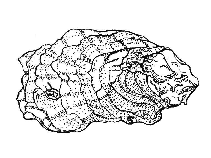
Diagnostic features: Shell lightweight, deep-cupped inequivalve, left valve (attached) larger than right. Shell shape and outline variable. Inner margin smooth. Presidium transversally striated. Colour: externally dirty light grey, internally whitish or light grey splotched with bluish purple (Ref. 271).
It has a total length of 12 cm. Fisheries: It is heavily exploited due to over exploitation or contaminated by organic pollutants. It is consumed raw, fried, grilled or boiled. Canned industrially (Ref. 271). Attached to roots of Rhizophora mangle, rocks or other oyster shells. It is mostly intertidal or shallow-subtidal species (Ref. 271).
Cycle de vie et comportement reproducteur
Maturité | Reproduction | Frai | Œufs | Fécondité | Larves
Members of the class Bivalvia are mostly gonochoric, some are protandric hermaphrodites. Life cycle: Embryos develop into free-swimming trocophore larvae, succeeded by the bivalve veliger, resembling a miniature clam.
Carpenter, K.E. (ed.) 2002 The living marine resources of the Western Central Atlantic. Volume 1: Introduction, molluscs, crustaceans, hagfishes, sharks, batoid fishes, and chimaeras. FAO Species Identification Guide for Fishery Purposes and American Society of Ichthyologists and Herpetologists Special Publication No. 5, Rome. 600p. (Réf. 271)
Statut dans la liste rouge de l'IUCN
(Réf. 130435: Version 2025-2 (Global))
statut CITES (Réf. 108899)
Not Evaluated
Not Evaluated
Menace pour l'homme
Utilisations par l'homme
Pêcheries: commercial
FAO - Aquaculture Systems: production searchpêcheries: landings search; Publication: search | FishSource | Sea Around Us
Outils
Plus d'informations
Dynamique des populationsCroissanceÂges / tailles maximalesLongueur-poids rel.Rel. longueur-longueur.Fréquences de longueursConversion de masseAbondance Cycle de vieReproductionMaturitéFéconditéFraiŒufsDéveloppement de l'œufLarves PhysiologieConsommation d'oxygène
Liées à l'hommeTimbres, pièces de monnaie, divers
Sources Internet
Estimations basées sur des modèles
Résilience
(Ref. 69278): |
Haut, temps minimum de doublement de population inférieur à 15 mois (K=2.79) |
Rate of population increase
|
Prior r = 0.81, 95% CL = 0.54 - 1.22, Based on 1 data-limited stock assessment. |
Vulnérabilité de la pêche
(Réf. 71543) |
Low vulnerability (10 of 100). |
Vulnérabilité climatique
(Réf. 125649) |
High vulnerability (57 of 100) |
Catégorie de prix
(Réf. 80766): |
High. |
Nutrients
|
Calcium = 149 [71, 228] mg/100g; Iron = 8.53 [1.95, 15.11] mg/100g; Protein = 9.88 [8.64, 11.12] %; Omega3 = 0.313 [0.202, 0.423] g/100g; Selenium = 61 [50, 72] μg/100g; VitaminA = 0 μg/100g; Zinc = 2.04 [0.56, 3.51] mg/100g (wet weight); based on nutrient studies. |