Bivalvia |
Ostreida |
Ostreidae
Milieu: milieu / Klimaatzone / Diepte / verspreidingsgebied
Ecologie
Benthic; brak water; diepte 0 - 50 m (Ref. 104365). Tropical, preferred 27°C (Ref. 107945); 25°N - 35°S, 96°W - 34°W
Atlantic Ocean: from southern Gulf of Mexico to Uruguay. Introduced in UK.
Lengte bij maturiteit / Grootte / Gewicht / Leeftijd
Maturiteit: Lm ? range ? - ? cm Max length : 12.0 cm NG mannelijk / geslacht onbekend; (Ref. 271)
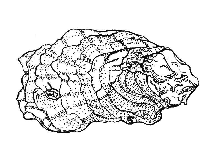
Diagnostic features: Shell lightweight, deep-cupped inequivalve, left valve (attached) larger than right. Shell shape and outline variable. Inner margin smooth. Presidium transversally striated. Colour: externally dirty light grey, internally whitish or light grey splotched with bluish purple (Ref. 271).
It has a total length of 12 cm. Fisheries: It is heavily exploited due to over exploitation or contaminated by organic pollutants. It is consumed raw, fried, grilled or boiled. Canned industrially (Ref. 271). Attached to roots of Rhizophora mangle, rocks or other oyster shells. It is mostly intertidal or shallow-subtidal species (Ref. 271).
Levenscyclus en paargedrag
Maturiteit | Voortplanting | Paaien | Eieren | Fecunditeit | Larven
Members of the class Bivalvia are mostly gonochoric, some are protandric hermaphrodites. Life cycle: Embryos develop into free-swimming trocophore larvae, succeeded by the bivalve veliger, resembling a miniature clam.
Carpenter, K.E. (ed.) 2002 The living marine resources of the Western Central Atlantic. Volume 1: Introduction, molluscs, crustaceans, hagfishes, sharks, batoid fishes, and chimaeras. FAO Species Identification Guide for Fishery Purposes and American Society of Ichthyologists and Herpetologists Special Publication No. 5, Rome. 600p. (Ref. 271)
Status op de Rode Lijst van het IUCN
(Ref. 130435: Version 2025-2 (Global))
CITES status (Ref. 108899)
Not Evaluated
Not Evaluated
Gevaar voor de mens
Gebruik door de mens
Visserij: commercieel
FAO - Aquaculture Systems: production searchvisserij: landings search; Publication: search | FishSource | Sea Around Us
Tools
Meer informatie
PopulatiedynamicaGroeiMax. leeftijden / matenLengte-gewicht rel.Lengte-lengte rel.LengtefrequentiesMassaconversieAbundantie LevenscyclusVoortplantingMaturiteitFecunditeitPaaienEierenOntwikkeling van de eierenLarven FysiologieZuurstofverbruik
Menselijk gerelateerdPostzegels, munten, diversen.
Internetbronnen
Schattingen op basis van modellen
Weerstandsvermogen
(Ref. 69278): |
Hoog, minimale populatieverdubbelingstijd minder dan 15 maanden (K=2.79) |
Rate of population increase
|
Prior r = 0.81, 95% CL = 0.54 - 1.22, Based on 1 data-limited stock assessment. |
Kwetsbaarheid van de visserij
(Ref. 71543) |
Low vulnerability (10 of 100). |
Kwetsbaarheid voor het klimaat
(Ref. 125649) |
High vulnerability (57 of 100) |
Prijsklasse
(Ref. 80766): |
High. |
Nutrients
|
Calcium = 149 [71, 228] mg/100g; Iron = 8.53 [1.95, 15.11] mg/100g; Protein = 9.88 [8.64, 11.12] %; Omega3 = 0.313 [0.202, 0.423] g/100g; Selenium = 61 [50, 72] μg/100g; VitaminA = 0 μg/100g; Zinc = 2.04 [0.56, 3.51] mg/100g (wet weight); based on nutrient studies. |