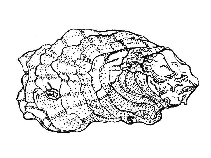
Bivalvia |
Ostreida |
Ostreidae
Ambiente: milieu / zona climatica / distribuzione batimetrica / gamma di distribuzione
Ecologia
Benthic; salmastro; distribuzione batimetrica 0 - 50 m (Fonte Biblio. 104365). Tropical, preferred 27°C (Fonte Biblio. 107945); 25°N - 35°S, 96°W - 34°W
Atlantic Ocean: from southern Gulf of Mexico to Uruguay. Introduced in UK.
Lunghezza alla prima maturità / Dimensione / Peso / Età
Maturità: Lm ? range ? - ? cm Max length : 12.0 cm NG maschio/sesso non determinato; (Fonte Biblio. 271)
Diagnostic features: Shell lightweight, deep-cupped inequivalve, left valve (attached) larger than right. Shell shape and outline variable. Inner margin smooth. Presidium transversally striated. Colour: externally dirty light grey, internally whitish or light grey splotched with bluish purple (Ref. 271).
It has a total length of 12 cm. Fisheries: It is heavily exploited due to over exploitation or contaminated by organic pollutants. It is consumed raw, fried, grilled or boiled. Canned industrially (Ref. 271). Attached to roots of Rhizophora mangle, rocks or other oyster shells. It is mostly intertidal or shallow-subtidal species (Ref. 271).
Ciclo vitale e comportamento di accoppiamento
Maturità | Riproduzione | Deposizione | Uova | Fecondità | Larve
Members of the class Bivalvia are mostly gonochoric, some are protandric hermaphrodites. Life cycle: Embryos develop into free-swimming trocophore larvae, succeeded by the bivalve veliger, resembling a miniature clam.
Carpenter, K.E. (ed.) 2002 The living marine resources of the Western Central Atlantic. Volume 1: Introduction, molluscs, crustaceans, hagfishes, sharks, batoid fishes, and chimaeras. FAO Species Identification Guide for Fishery Purposes and American Society of Ichthyologists and Herpetologists Special Publication No. 5, Rome. 600p. (Fonte Biblio. 271)
Stato della Lista Rossa IUCN
(Fonte Biblio. 130435: Version 2025-2 (Global))
Stato della CITES (Fonte Biblio. 108899)
Not Evaluated
CMS (Fonte Biblio. 116361)
Not Evaluated
Minaccia per l'uomo
Usi umani
Pesca: commerciale
FAO - Aquaculture Systems: production searchpesca: landings search; Publication: search | FishSource | Sea Around Us
Strumenti
Informazioni ulteriori
Dinamica della popolazioneAccrescimentoEtà massima / dimensioni massimeRapporto lunghezza-peso.Lunghezza-lunghezza rel.Lunghezza-frequenzeConversione di massaAbbondanza Ciclo di vitaRiproduzioneMaturitàFeconditàDeposizioneUovaSviluppo delle uovaLarve FisiologiaConsumo di ossigeno
Legato all'uomoFrancobolli, monete, materiale vario.
Fonti Internet
Stime basate su modelli
Resilienza
(Ref. 69278): |
Alto, tempo minimo di raddoppiamento della popolazione meno di 15 mesi (K=2.79) |
Rate of population increase
|
Prior r = 0.81, 95% CL = 0.54 - 1.22, Based on 1 data-limited stock assessment. |
Vulnerabilità della pesca
(Fonte Biblio. 71543) |
Low vulnerability (10 of 100). |
Vulnerabilità climatica
(Fonte Biblio. 125649) |
High vulnerability (57 of 100) |
Categoria di prezzo
(Fonte Biblio. 80766): |
High. |
Nutrients
|
Calcium = 149 [71, 228] mg/100g; Iron = 8.53 [1.95, 15.11] mg/100g; Protein = 9.88 [8.64, 11.12] %; Omega3 = 0.313 [0.202, 0.423] g/100g; Selenium = 61 [50, 72] μg/100g; VitaminA = 0 μg/100g; Zinc = 2.04 [0.56, 3.51] mg/100g (wet weight); based on nutrient studies. |