Malacostraca |
Decapoda |
Palinuridae
Ambiente: milieu / zona climática / intervalo de profundidade / gama de distribuição
Ecologia
Benthic; intervalo de profundidade 5 - 200 m (Ref. 85369), usually 10 - 70 m (Ref. 4). Subtropical; 12°C - 16°C (Ref. 114562), preferred 11°C (Ref. 107945); 60°N - 27°N, 32°W - 36°E
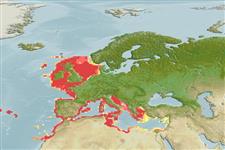
Eastern Atlantic and the Mediterranean: from Orkney Isles, UK Scotland to Canary Islands, east to Turkey. Temperate to subtropical.
Comprimento na primeira maturidade / Tamanho / Peso / Idade
Maturidade: Lm 10.0, range 7 - 8 cm Max length : 50.0 cm TL macho/indeterminado; (Ref. 441); common length : 40.0 cm BASL macho/indeterminado; (Ref. 441); Idade máx. registada: 15 anos (Ref. 85318)
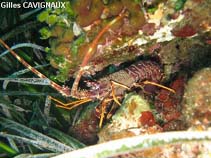
Traditionally caught by traps, pots and sometimes by hand (e.g., diving and spearing; Refs. 441'>441, 85369), but these gears were eventually replaced with trammel nets (Ref. 85369). Minimum depth from Ref. 4. Occurs at depths between shore to 200 m, on rocky bottoms and coralligenous substrates where there are lots of protective holes and micro-caves. Adults may be solitary, in pairs or in small groups. Highly omnivorous and preys on hard-shelled bottom dwelling organisms, i.e., mollusks, echinoderms and crustaceans. They are generalists and opportunistic feeders depending on the abundance of benthic organisms (Ref. 85369). Ovigerous females are observed from September to October and February to March (Ref. 4).
Breeds once a year between June and October. Larger females mate and lay eggs earlier during breeding season while smaller females spawn towards the end (Ref. 85364).
Holthuis, L.B. 1991 FAO Species Catalogue. Vol. 13. Marine lobsters of the world. An annotated and illustrated catalogue of species of interest to fisheries known to date. FAO Fish. Synop. 125(13):292p. Rome: FAO. (Ref. 4)
Categoria na Lista Vermelha da IUCN
(Ref. 130435: Version 2025-2 (Global))
Categoria CITES (Ref. 108899)
Not Evaluated
Not Evaluated
Ameaça para o homem
Utilização humana
Pescarias: espécies comerciais
FAO - pescarias: landings search; Publication: search | FishSource | Sea Around Us
Ferramentas
Mais informação
FisiologiaConsumo de oxigénio
Relacionado com o ser humano
Fontes da internet
Estimativas baseadas em modelos
Resiliência
(Ref. 69278): |
Médio, tempo mínimo de duplicação da população 1,4 - 4,4 anos (K=0.13-0.21; tm=4; tmax=15) |
Rate of population increase
|
Prior r = 0.22, 95% CL = 0.14 - 0.33, Based on 4 data-limited stock assessments. |
Vulnerabilidade da pesca
(Ref. 71543) |
Moderate to high vulnerability (54 of 100). |
Vulnerabilidade climática
(Ref. 125649) |
Moderate vulnerability (38 of 100) |
Categoria de preço
(Ref. 80766): |
Very high. |
Nutrients
|
Calcium = 109 [35, 184] mg/100g; Iron = 1.59 [1.21, 1.97] mg/100g; Protein = 20.2 [19.2, 21.3] %; Omega3 = 0.285 [0.185, 0.386] g/100g; Selenium = 48.3 [-31.7, 128.3] μg/100g; VitaminA = 0 μg/100g; Zinc = 1.79 [1.17, 2.40] mg/100g (wet weight); based on nutrient studies. |