Not assigned |
Squamata |
Elapidae
Umwelt: Milieu / Klimazone / Tiefenbereich / Verbreitungsgebiet
Ökologie
Riff-verbunden; tiefenbereich 3 - 22 m (Ref. 78387). Tropical; 31°N - 58°S (Ref. 356)
Indo-West Pacific.
Länge bei der ersten Reifung / Größe / Gewicht / Alter
Geschlechtsreife: Lm 74.5, range 47 - 101.5 cm Max length : 140 cm TL Männchen/unbestimmt; (Ref. 801); common length : 110 cm TL Männchen/unbestimmt; (Ref. 801)
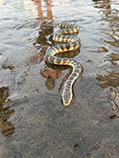
Young has gray to black annuli, while juveniles has 45-55 transverse bars that may extend down the flanks with the lower body whitish and without pattern. Adults are uniform gray above, whitish below. Dark bars wider or as wide than paler interspaces.
Average length is 90 cm. The venom of this snake is said to be responsible for more serious and fatal bites than all other sea snakes combined and is considered to have the most toxic venom. Based on studies, the myotoxic phospholipase A from the venom causes myoglobinuria in mice (Ref. 88062). Usually occurs in clear shallow reef waters (Ref. 2357), and may travel about ten miles up tidal rivers (Ref. 88062). Also prefers estuarine conditions in Australia (Ref. 2357). Ovoviviparous (Ref. 801), with 4 to 9 young ones in a brood (Ref. 88062). Feeds on fish (Refs. 801, 88062).
Lebenszyklus und Paarungsverhalten
Geschlechtsreife | Fortpflanzung | Ablaichen | Eier | Fruchtbarkeit | Larven
Ovoviviparous (Ref. 801). It bears 4 to 9 young ones in a brood (Ref. 88062).
Redfield, J.A., J.C. Holmes and R.D. Holmes 1978 Sea snakes of the Eastern Gulf of Carpentaria. Aust. J. Mar. Freshwat. Res. 29(3):325-334. (Ref. 78387)
IUCN Rote Liste Status
(Ref. 130435: Version 2025-2 (Global))
CITES Status (Ref. 108899)
Not Evaluated
Not Evaluated
Bedrohung für Menschen
Nutzung durch Menschen
Fischereien: nicht kommerziell
FAO - Publication: search | FishSource |
Tools
Mehr Information
PhysiologieSauerstoffverbrauch
MenschenbezogenBriefmarken, Münzen, Verschiedenes.
Internet Quellen
Schätzungen auf der Grundlage von Modellen
Widerstandsfähigkeit
(Ref. 69278): |
hoch, Verdopplung der Population dauert weniger als 15 Monate. (K=0.6-0.75) |
Anfälligkeit der Fischerei
(Ref. 71543) |
Moderate to high vulnerability (46 of 100). |
Preiskategorie
(Ref. 80766): |
Unknown. |