Not assigned |
Squamata |
Elapidae
Milieu: milieu / Klimaatzone / Diepte / verspreidingsgebied
Ecologie
Rifbewoner; diepte 3 - 22 m (Ref. 78387). Tropical; 31°N - 58°S (Ref. 356)
Indo-West Pacific.
Lengte bij maturiteit / Grootte / Gewicht / Leeftijd
Maturiteit: Lm 74.5, range 47 - 101.5 cm Max length : 140 cm TL mannelijk / geslacht onbekend; (Ref. 801); common length : 110 cm TL mannelijk / geslacht onbekend; (Ref. 801)
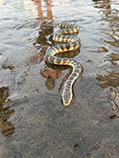
Young has gray to black annuli, while juveniles has 45-55 transverse bars that may extend down the flanks with the lower body whitish and without pattern. Adults are uniform gray above, whitish below. Dark bars wider or as wide than paler interspaces.
Average length is 90 cm. The venom of this snake is said to be responsible for more serious and fatal bites than all other sea snakes combined and is considered to have the most toxic venom. Based on studies, the myotoxic phospholipase A from the venom causes myoglobinuria in mice (Ref. 88062). Usually occurs in clear shallow reef waters (Ref. 2357), and may travel about ten miles up tidal rivers (Ref. 88062). Also prefers estuarine conditions in Australia (Ref. 2357). Ovoviviparous (Ref. 801), with 4 to 9 young ones in a brood (Ref. 88062). Feeds on fish (Refs. 801, 88062).
Levenscyclus en paargedrag
Maturiteit | Voortplanting | Paaien | Eieren | Fecunditeit | Larven
Ovoviviparous (Ref. 801). It bears 4 to 9 young ones in a brood (Ref. 88062).
Redfield, J.A., J.C. Holmes and R.D. Holmes 1978 Sea snakes of the Eastern Gulf of Carpentaria. Aust. J. Mar. Freshwat. Res. 29(3):325-334. (Ref. 78387)
Status op de Rode Lijst van het IUCN
(Ref. 130435: Version 2025-2 (Global))
CITES status (Ref. 108899)
Not Evaluated
Not Evaluated
Gevaar voor de mens
Gebruik door de mens
Visserij: van geen belang
FAO - Publication: search | FishSource |
Tools
Meer informatie
FysiologieZuurstofverbruik
Menselijk gerelateerdPostzegels, munten, diversen.
Internetbronnen
Schattingen op basis van modellen
Weerstandsvermogen
(Ref. 69278): |
Hoog, minimale populatieverdubbelingstijd minder dan 15 maanden (K=0.6-0.75) |
Kwetsbaarheid van de visserij
(Ref. 71543) |
Moderate to high vulnerability (46 of 100). |
Prijsklasse
(Ref. 80766): |
Unknown. |