Mammalia |
Cetartiodactyla |
Delphinidae
สิ่งแวดล้อม : สิ่งแวดล้อม / เขตภูมิอากาศ / ระดับความลึก / ระยะการกระจายสินค้า
นิเวศวิทยา
ผิวน้ำ; สัตว์น้ำที่อาศัยและอพยพภายในทะเลเท่านั้น (อ้างอิง 75906); ระดับความลึก 0 - 2652 m (อ้างอิง 116169). Tropical; 90°N - 90°S, 180°W - 180°E
Circumglobal. Climate: cosmopolitan.
ความยาวเมื่อครบกำหนดครั้งแรก / ขนาด / น้ำหนัก / อายุ
วัยเจริญพันธุ์: Lm ?, range 570 - 660 cm Max length : 980 cm TL เพศผู้/กระเทย; (อ้างอิง 1394); 850 cm TL (female); น้ำหนักสูงสุดที่มีการรายงาน: 10.0 t (อ้างอิง 1394)
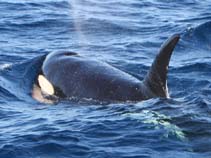
Transient migration (Ref. 8689). Lives in matrilines throughout their lifetime (Ref. 97337). Commonly found in nearshore, cold temperate to subpolar waters (Refs. 1394, 936). Forms large social groups and strong social bonds. Feeds cooperatively (Refs. 122680, 130961). Feeds on sharks, large baleen whales (Ref. 122680), all oceanic cetaceans, pinniped, penguins, and other seabirds, leatherback turtles, squid and many types of fish (Refs. 1394, 936). Three ecotypes identified along California and Oregon: residents (piscivorous), transients (mammal-eating) and offshores (preference for shark and other large fishes). Bite marks indicate attacks from Isistius sp. (Ref. 130791).
Polygamous (Ref. 8653). Sexually dimorphic; males are larger than females (Ref. 97315). Females have higher preference for non-pod males that arrive as part of a matriline than males that arrive alone. Multiple mating occurs based on testis size to body size ratios; females mate with more than one male during associations between pods (Ref. 97337). Calving is diffusely seasonal, with a peak in autumn for northeastern Pacific species (Ref. 97343).
Tan, J.M.L. 1995 A Field Guide to the Whales and Dolphins in the Philippines. Makati City: Bookmark. 125 p. (อ้างอิง 936)
สถานะบัญชีแดงของ IUCN
(อ้างอิง 130435: Version 2025-2 (Global))
สถานะไซเตส (อ้างอิง 108899)
CMS (อ้างอิง 116361)
ภัยคุกคามต่อมนุษย์
การใช้ของมนุษย์
การประมง: การค้า
FAO - การประมง: โปรไฟล์สายพันธุ์, landings search; Publication: search | FishSource | ทะเลรอบๆเรา
เครื่องมือ
ข้อมูลเพิ่มเติม
เกี่ยวข้องกับมนุษย์แสตมป์ เหรียญ อื่นๆ
แหล่งที่มาจากอินเตอร์เน็ต
การประมาณค่าตามแบบจำลอง
ความสามารถในการกลับคืนสู่ปกติ
(Ref. 69278): |
ต่ำ, เวลาต่ำสุดที่จะทำให้ประชากรเพิ่มขึ้นเป็น 2 เท่าใช้เวลา 4.5 - 14 ปี (K=0.1-0.17; tm=9.4) |
ความเสี่ยงต่อการตกปลา
(อ้างอิง 71543) |
Very high vulnerability (81 of 100). |
หมวดหมู่ราคา
(อ้างอิง 80766): |
Unknown. |