Mammalia |
Cetartiodactyla |
Delphinidae
Environnement : milieu / zone climatique / profondeur / gamme de distribution
Écologie
Pélagique; océanodrome (Réf. 75906); profondeur 0 - 2652 m (Réf. 116169). Tropical; 90°N - 90°S, 180°W - 180°E
Circumglobal. Climate: cosmopolitan.
Longueur à la première maturité / Taille / Poids / Âge
Maturité: Lm ?, range 570 - 660 cm Max length : 980 cm TL mâle / non sexé; (Réf. 1394); 850 cm TL (female); poids max. publié: 10.0 t (Réf. 1394)
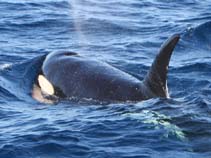
Transient migration (Ref. 8689). Lives in matrilines throughout their lifetime (Ref. 97337). Commonly found in nearshore, cold temperate to subpolar waters (Refs. 1394, 936). Forms large social groups and strong social bonds. Feeds cooperatively (Refs. 122680, 130961). Feeds on sharks, large baleen whales (Ref. 122680), all oceanic cetaceans, pinniped, penguins, and other seabirds, leatherback turtles, squid and many types of fish (Refs. 1394, 936). Three ecotypes identified along California and Oregon: residents (piscivorous), transients (mammal-eating) and offshores (preference for shark and other large fishes). Bite marks indicate attacks from Isistius sp. (Ref. 130791).
Cycle de vie et comportement reproducteur
Maturité | Reproduction | Frai | Œufs | Fécondité | Larves
Polygamous (Ref. 8653). Sexually dimorphic; males are larger than females (Ref. 97315). Females have higher preference for non-pod males that arrive as part of a matriline than males that arrive alone. Multiple mating occurs based on testis size to body size ratios; females mate with more than one male during associations between pods (Ref. 97337). Calving is diffusely seasonal, with a peak in autumn for northeastern Pacific species (Ref. 97343).
Tan, J.M.L. 1995 A Field Guide to the Whales and Dolphins in the Philippines. Makati City: Bookmark. 125 p. (Réf. 936)
Statut dans la liste rouge de l'IUCN
(Réf. 130435: Version 2025-2 (Global))
statut CITES (Réf. 108899)
Menace pour l'homme
Utilisations par l'homme
Pêcheries: commercial
FAO - pêcheries: Résumé espèce, landings search; Publication: search | FishSource | Sea Around Us
Outils
Plus d'informations
Dynamique des populations PhysiologieConsommation d'oxygène
Liées à l'hommeTimbres, pièces de monnaie, divers
Sources Internet
Estimations basées sur des modèles
Résilience
(Ref. 69278): |
Faible, temps minimum de doublement de population : 4,5 à 14 années (K=0.1-0.17; tm=9.4) |
Vulnérabilité de la pêche
(Réf. 71543) |
Very high vulnerability (81 of 100). |
Catégorie de prix
(Réf. 80766): |
Unknown. |