Mammalia |
Cetartiodactyla |
Delphinidae
Entorno: milieu / zona climática / rango de profundidad / gama de distribución
Ecología
Pelágico; oceanodromo (Referencia 75906); rango de profundidad 0 - 2652 m (Referencia 116169). Tropical; 90°N - 90°S, 180°W - 180°E
Circumglobal. Climate: cosmopolitan.
Longitud en la primera madurez / Tamaño / Peso / Edad
Madurez: Lm ?, range 570 - 660 cm Max length : 980 cm TL macho / no sexado; (Referencia 1394); 850 cm TL (female); peso máximo publicado: 10.0 t (Referencia 1394)
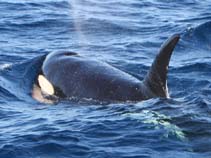
Transient migration (Ref. 8689). Lives in matrilines throughout their lifetime (Ref. 97337). Commonly found in nearshore, cold temperate to subpolar waters (Refs. 1394, 936). Forms large social groups and strong social bonds. Feeds cooperatively (Refs. 122680, 130961). Feeds on sharks, large baleen whales (Ref. 122680), all oceanic cetaceans, pinniped, penguins, and other seabirds, leatherback turtles, squid and many types of fish (Refs. 1394, 936). Three ecotypes identified along California and Oregon: residents (piscivorous), transients (mammal-eating) and offshores (preference for shark and other large fishes). Bite marks indicate attacks from Isistius sp. (Ref. 130791).
Polygamous (Ref. 8653). Sexually dimorphic; males are larger than females (Ref. 97315). Females have higher preference for non-pod males that arrive as part of a matriline than males that arrive alone. Multiple mating occurs based on testis size to body size ratios; females mate with more than one male during associations between pods (Ref. 97337). Calving is diffusely seasonal, with a peak in autumn for northeastern Pacific species (Ref. 97343).
Tan, J.M.L. 1995 A Field Guide to the Whales and Dolphins in the Philippines. Makati City: Bookmark. 125 p. (Referencia 936)
Situación en la Lista Roja de la UICN
(Referencia 130435: Version 2025-2 (Global))
Estatus CITES (Referencia 108899)
CMS (Referencia 116361)
Amenaza para el ser humano
Usos humanos
Pesquerías: comercial
FAO - pesquerías: perfil de la especie, landings search; Publication: search | FishSource | Sea Around Us
Herramientas
Más información
FisiologíaConsumo del oxígeno
Relacionados con el ser humanoSellos, monedas, varios
Fuentes de Internet
Estimaciones basadas en modelos
Resiliencia
(Ref. 69278): |
Bajo, población duplicada en un tiempo mínimo de 4.5-14 años (K=0.1-0.17; tm=9.4) |
Vulnerabilidad pesquera
(Referencia 71543) |
Very high vulnerability (81 of 100). |
Categoría de precios
(Referencia 80766): |
Unknown. |