Mammalia |
Cetartiodactyla |
Delphinidae
Miljö: miljö / Klimatzon / djupintervall / distributionsområde
Ekologi
Pelagic-oceanic; havsvandrande (Ref. 75906); djupintervall 0 - 2000 m (Ref. 138071). Tropical; 10°C - 28°C (Ref. 75906); 90°N - 90°S, 180°W - 180°E
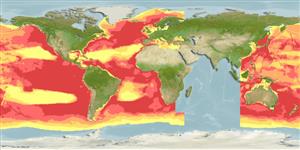
Indo-Pacific, Atlantic Ocean and Mediterranean and Black Sea. Warm temperate and tropical waters. It is not reported in Antarctic territories (Ref. 128552) [Mediterranean population: IUCN 2010 (Ref. 84930): EN, A2abc.]
Längd vid första mognad / Storlek / Vikt / Ålder
Könsmognad: Lm ?, range 160 - 190 cm Max length : 260 cm TL hane/ej könsbestämd; (Ref. 1394); 230 cm TL (female); publicerad maxvikt: 135.0 kg (Ref. 1394)
Found in tropical coastal waters (Ref. 1522). Inhabits neritic waters over continental shelves (Ref. 80684). Usually found offshore. Commonly in large herds of 30 or more individuals (Ref. 801). Feeds on small schooling fish and squid; at night on creatures associated with the deep scattering layer (DSL), which migrates towards the surface in the dark (Ref. 1394). Preyed upon by great white sharks (Ref. 8891). Delphinus capensis tropicalis: They were reported to bow ride although not in areas particularly where hunting occurs. Schools in offshore areas are somewhat larger than coastal ones. Some form mixed schools with spinner dolphins (Stenella longirostris), and remains on the outskirts of the spinner school generally. Sexual maturity probably occurs at 200 cm. It is associated with Sardinella sp., various tunas, stomach nematodes, cirriped barnacles, and the isopod Cirolana parva (Ref. 79556).
Livscykel och parningsbeteende
Könsmognad | Reproduktion | Lek | Ägg | Fekunditet | Larver
Seasonal reproduction (Ref. 97375).
Jefferson, T.A., S. Leatherwood and M.A. Webber 1993 FAO species Identification Guide: Marine Mammals of the World. Rome, FAO. 320 p. + 587 figures. (Ref. 1394)
Status på IUCN:s rödlista
(Ref. 130435: Version 2025-2 (Global))
CITES-status (Ref. 108899)
Hot mot människor
Mänskliga användningsområden
Fiskeri: kommersiell
FAO - fiskeri: artprofil, landings search; Publication: search | FishSource | Havet omkring oss
Verktyg
Ytterligare information
MänniskorelateradFrimärken, mynt, diverse.
Internet-källor
Uppskattningar baserade på modeller
Resiliens
(Ref. 69278): |
Mellan, lägsta populationsfördubblingstid 1,4-4,4 år (K=0.2; tm=9) |
Sårbarhet i fisket
(Ref. 71543) |
Very high vulnerability (75 of 100). |
Priskategori
(Ref. 80766): |
Unknown. |