Mammalia |
Carnivora |
Ursidae
Ambiente: milieu / zona climática / intervalo de profundidade / gama de distribuição
Ecologia
Demersal. Polar
Atlantic Ocean and the Arctic: Ursus maritimus maritimus: Canada, Northwest Territories, Baffin Island, Greenland, Svalbard, Russia, Labrador, Newfoundland, Quebec, Iceland, Norway; Ursus maritimus marinus: Russia, Beaufort Sea, Alaska, Bering Sea, Kamchatka, Kuril Island, Sea of Okhotsk, Japan (Ref. 1522).
Comprimento na primeira maturidade / Tamanho / Peso / Idade
Maturidade: Lm ? range ? - ? cm Max length : 250 cm TL macho/indeterminado; (Ref. 1394); 200 cm TL (female); peso máx. Publicado: 800.0 kg (Ref. 1394); peso máx. Publicado: 800.0 kg
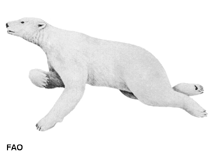
Fur color: white, yellow, grey, or almost brown, depending on season and light conditions; black skin, including nose and lips; plantigrade; claws not retractable.
Generally associated with ice, but they have been swimming at sea many kilometers away from the nearest land. Feeds on ringed, bearded, harp and hooded seals, and rarely walruses and white whales; sometimes eat arctic cod and other forms of animal and vegetable matter (Ref. 1394). Generally associated with ice, but they have been swimming at sea many kilometers away from the nearest land. Feeds on ringed, bearded, harp and hooded seals, and rarely walruses and white whales; sometimes eat arctic cod (Ref. 1394), charr, sculpin, and plants (Ref. 81152). They display migration patterns and spend time on the ice for hunting, a positive energy state, and move to their terrestrial habitat, a negative energy state, when the ice melts. Earlier ice break-ups show earlier arrival of polar bears ashore (Ref. 93189).
Jefferson, T.A., S. Leatherwood and M.A. Webber 1993 FAO species Identification Guide: Marine Mammals of the World. Rome, FAO. 320 p. + 587 figures. (Ref. 1394)
Categoria na Lista Vermelha da IUCN
(Ref. 130435: Version 2025-2 (Global))
Categoria CITES (Ref. 108899)
Ameaça para o homem
Utilização humana
Pescarias: espécies comerciais
FAO - pescarias: perfil da espécie; Publication: search | FishSource | Sea Around Us
Ferramentas
Mais informação
FisiologiaConsumo de oxigénio
Relacionado com o ser humanoSelos, moedas, diversos.
Fontes da internet
Estimativas baseadas em modelos
Resiliência
(Ref. 69278): |
Elevada, tempo mínimo de duplicação da população menor que 15 meses (K=0.52-0.78; tm=4.1) |
Vulnerabilidade da pesca
(Ref. 71543) |
High vulnerability (64 of 100). |
Categoria de preço
(Ref. 80766): |
Unknown. |