Mammalia |
Carnivora |
Phocidae
Umwelt: Milieu / Klimazone / Tiefenbereich / Verbreitungsgebiet
Ökologie
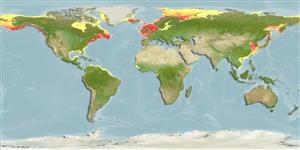
Bathydemersal. Temperate; 90°N - 0°S, 180°W - 180°E
Atlantic Ocean, Pacific Ocean, the Arctic and North America Inland Waters: Portugal, Iceland, Greenland, Canada Newfoundland, Spain, France, Belgium, Ireland, Netherlands, Germany, Denmark, Norway, Sweden Lithuania, Poland, Latvia, Estonia, Finland, Russia, UK, USA, Canada, Mexico, Alaska, Japan, Kamchatka (Ref. 1394), Br Scotland, Madeira, British Columbia, Kuril Island, Sea of Okhotsk, Gulf of California, Baltic Sea, Barents Sea, Hudson Bay (Ref. 1522); Phoca vitulina vitulina: Portugal, UK, Iceland, Greenland, Br Scotland, Norway, Madeira, Baltic Sea, Barents Sea; Phoca vitulina concolor: Canada, Hudson Bay, USA, Greenland, Iceland; Phoca vitulina richardii: Mexico, Alaska, British Columbia, USA, Gulf of California; Phoca vitulina stejnegeri: Japan, Kamchatka, Alaska, Sea of Okhotsk, Kuril Island; Phoca vitulina mellonae: Hudson Bay, James Bay. Temperate to polar regions.
Länge bei der ersten Reifung / Größe / Gewicht / Alter
Geschlechtsreife: Lm ? range ? - ? cm Max length : 190 cm TL Männchen/unbestimmt; (Ref. 1394); 170 cm TL (female); max. veröff. Gewicht: 150.0 kg (Ref. 1394); max. veröff. Gewicht: 150.0 kg
Found in coastal waters of the continental shelf and slope (Ref. 1394); and whelp in groups on beaches, sandbars, and rocky reefs (Ref. 1522). Feeds on a wide variety of fish, cephalopods, and crustaceans of surface, mid-water and benthic habitats (Ref. 1394). It is preyed upon by the great white shark (Ref. 32140). Found in coastal waters of the continental shelf and slope (Ref. 1394); and whelp in groups on beaches, sandbars, and rocky reefs (Ref. 1522). Also for resting, moulting and lactation during low tides. Typically perform U-shaped dives. Leave the coast on foraging trips to deeper offshore waters where prey is abundant (Ref. 96347). Feeds on a wide variety of fish, cephalopods, and crustaceans of surface, mid-water and benthic habitats (Ref. 1394).
Lebenszyklus und Paarungsverhalten
Geschlechtsreife | Fortpflanzung | Ablaichen | Eier | Fruchtbarkeit | Larven
Jefferson, T.A., S. Leatherwood and M.A. Webber 1993 FAO species Identification Guide: Marine Mammals of the World. Rome, FAO. 320 p. + 587 figures. (Ref. 1394)
IUCN Rote Liste Status
(Ref. 130435: Version 2025-2 (Global))
CITES Status (Ref. 108899)
Not Evaluated
Bedrohung für Menschen
Nutzung durch Menschen
Fischereien: kommerziell
FAO - Fischereien: Artbeschreibung, landings search; Publication: search | FishSource | Das Meer um uns herum
Tools
Mehr Information
LebenszyklusFortpflanzungGeschlechtsreifeFruchtbarkeitAblaichenEierEientwicklungLarven PhysiologieSauerstoffverbrauch
MenschenbezogenBriefmarken, Münzen, Verschiedenes.
Internet Quellen
Schätzungen auf der Grundlage von Modellen
Widerstandsfähigkeit
(Ref. 69278): |
mittel, Verdopplung der Population dauert 1,4 - 4,4 Jahre. (K=0.09-0.4) |
Anfälligkeit der Fischerei
(Ref. 71543) |
High to very high vulnerability (74 of 100). |
Preiskategorie
(Ref. 80766): |
Unknown. |