Mammalia |
Carnivora |
Phocidae
Environnement : milieu / zone climatique / profondeur / gamme de distribution
Écologie
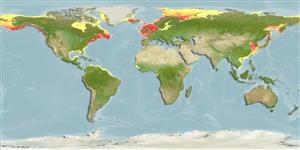
Bathydémersal. Temperate; 90°N - 0°S, 180°W - 180°E
Atlantic Ocean, Pacific Ocean, the Arctic and North America Inland Waters: Portugal, Iceland, Greenland, Canada Newfoundland, Spain, France, Belgium, Ireland, Netherlands, Germany, Denmark, Norway, Sweden Lithuania, Poland, Latvia, Estonia, Finland, Russia, UK, USA, Canada, Mexico, Alaska, Japan, Kamchatka (Ref. 1394), Br Scotland, Madeira, British Columbia, Kuril Island, Sea of Okhotsk, Gulf of California, Baltic Sea, Barents Sea, Hudson Bay (Ref. 1522); Phoca vitulina vitulina: Portugal, UK, Iceland, Greenland, Br Scotland, Norway, Madeira, Baltic Sea, Barents Sea; Phoca vitulina concolor: Canada, Hudson Bay, USA, Greenland, Iceland; Phoca vitulina richardii: Mexico, Alaska, British Columbia, USA, Gulf of California; Phoca vitulina stejnegeri: Japan, Kamchatka, Alaska, Sea of Okhotsk, Kuril Island; Phoca vitulina mellonae: Hudson Bay, James Bay. Temperate to polar regions.
Longueur à la première maturité / Taille / Poids / Âge
Maturité: Lm ? range ? - ? cm Max length : 190 cm TL mâle / non sexé; (Réf. 1394); 170 cm TL (female); poids max. publié: 150.0 kg (Réf. 1394); poids max. publié: 150.0 kg
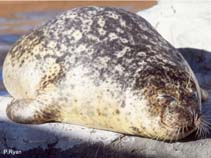
Found in coastal waters of the continental shelf and slope (Ref. 1394); and whelp in groups on beaches, sandbars, and rocky reefs (Ref. 1522). Feeds on a wide variety of fish, cephalopods, and crustaceans of surface, mid-water and benthic habitats (Ref. 1394). It is preyed upon by the great white shark (Ref. 32140). Found in coastal waters of the continental shelf and slope (Ref. 1394); and whelp in groups on beaches, sandbars, and rocky reefs (Ref. 1522). Also for resting, moulting and lactation during low tides. Typically perform U-shaped dives. Leave the coast on foraging trips to deeper offshore waters where prey is abundant (Ref. 96347). Feeds on a wide variety of fish, cephalopods, and crustaceans of surface, mid-water and benthic habitats (Ref. 1394).
Cycle de vie et comportement reproducteur
Maturité | Reproduction | Frai | Œufs | Fécondité | Larves
Jefferson, T.A., S. Leatherwood and M.A. Webber 1993 FAO species Identification Guide: Marine Mammals of the World. Rome, FAO. 320 p. + 587 figures. (Réf. 1394)
Statut dans la liste rouge de l'IUCN
(Réf. 130435: Version 2025-2 (Global))
statut CITES (Réf. 108899)
Not Evaluated
Menace pour l'homme
Utilisations par l'homme
Pêcheries: commercial
FAO - pêcheries: Résumé espèce, landings search; Publication: search | FishSource | Sea Around Us
Outils
Plus d'informations
Dynamique des populations Cycle de vieReproductionMaturitéFéconditéFraiŒufsDéveloppement de l'œufLarves PhysiologieConsommation d'oxygène
Liées à l'hommeTimbres, pièces de monnaie, divers
Sources Internet
Estimations basées sur des modèles
Résilience
(Ref. 69278): |
Milieu, temps minimum de doublement de population : 1,4 à 4,4 années (K=0.09-0.4) |
Vulnérabilité de la pêche
(Réf. 71543) |
High to very high vulnerability (74 of 100). |
Catégorie de prix
(Réf. 80766): |
Unknown. |