Bivalvia |
Ostreida |
Ostreidae
Môi trường: môi trường / vùng khí hậu / Mức độ sâu / phạm vi phân phối
Sinh thái học
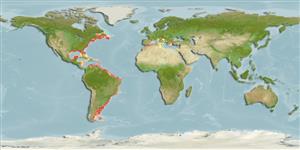
Benthic; thuộc về nước lợ; mức độ sâu 0 - 79 m (Tài liệu tham khảo 83435). Subtropical, preferred 22°C (Tài liệu tham khảo 107945); 51°N - 50°S, 98°W - 35°W
Western Atlantic: from Gulf of St. Lawrence, Canada to Tamaulipas, Mexico south to Argentina. Introduced in Northeast Atlantic, Mediterranean Sea and the Pacific Ocean.
Chiều dài lúc trưởng thành đầu tiên / Bộ gần gũi / Khối lượng (Trọng lượng) / Tuổi
Chín muồi sinh dục: Lm ? range ? - ? cm Max length : 35.5 cm SHL con đực/không giới tính; (Tài liệu tham khảo 96280); Tuổi cực đại được báo cáo: 2.00 các năm (Tài liệu tham khảo 2823)
Diagnostic features: Shell thick and heavy, usually narrow and elongate, but extremely variable in shape. Upper valve flatter, smaller than lower valve; lower valve convex. Shell shape and outline variable. Shell margins undulating straight. Umbones long and curved. Colour: dirty to light grey, internally white with muscle scar deep purple (Ref. 271).
Attached to rocks, other oyster shells, or other hard substrates (Ref. 271). Favors estuaries and embayments with low salinities and are intolerant of prolonged exposure to fresh water or marine conditions. They may either be filter feeders (Ref. 96280) or suspension feeders (Ref. 3248). Found in shallow water of tidal to subtidal depth of fairly constant turbidity and salinity (Ref. 3248) and salt marshes (Ref. 2823). Main sources of food are phytoplankton, suspended detritus particles (Ref. 96280) and bacteria (Ref. 101343). Able to regulate its feeding rates based on differences in size, type and composition of the food source (Ref. 96280).
Gonochoristic (separate male and females). After external fertilization, the developing larvae or veliger settles to the bottom after a time in the plankton stage. First spawning usually occurs when oyster is two years of age (Ref. 3248).
Carpenter, K.E. (ed.) 2002 The living marine resources of the Western Central Atlantic. Volume 1: Introduction, molluscs, crustaceans, hagfishes, sharks, batoid fishes, and chimaeras. FAO Species Identification Guide for Fishery Purposes and American Society of Ichthyologists and Herpetologists Special Publication No. 5, Rome. 600p. (Tài liệu tham khảo 271)
Tình trạng Sách đỏ IUCN
(Tài liệu tham khảo 130435: Version 2025-2 (Global))
tình trạng CITES (Tài liệu tham khảo 108899)
Not Evaluated
CMS (Tài liệu tham khảo 116361)
Not Evaluated
Mối đe dọa đối với con người
Sử dụng của con người
Các nghề cá: tính thương mại; Nuôi trồng thủy sản: tính thương mại
FAO - Aquaculture Systems: hồ sơ loài, production search; Các nghề cá: hồ sơ loài, landings search; Publication: search | FishSource | Biển chung quanh ta
Các công cụ
Thêm thông tin
Sinh lý họcThành phần ô-xy
Liên quan đến con ngườiTem, tiền xu, v.v.
Các nguồn internet
Ước tính dựa trên mô hình
Rate of population increase
|
Prior r = 0.72, 95% CL = 0.47 - 1.07, Based on 1 full stock assessment. |
Sự dễ bị tổn thương của nghề đánh cá
(Tài liệu tham khảo 71543) |
Low to moderate vulnerability (27 of 100). |
Sự dễ bị tổn thương của khí hậu
(Tài liệu tham khảo 125649) |
High vulnerability (57 of 100) |
Loại giá
(Tài liệu tham khảo 80766): |
Low. |
Nutrients
|
Calcium = 149 [71, 228] mg/100g; Iron = 8.53 [1.95, 15.11] mg/100g; Protein = 9.88 [8.64, 11.12] %; Omega3 = 0.313 [0.202, 0.423] g/100g; Selenium = 61 [50, 72] μg/100g; VitaminA = 0 μg/100g; Zinc = 2.04 [0.56, 3.51] mg/100g (wet weight); based on nutrient studies. |