Bivalvia |
Ostreida |
Ostreidae
Environnement : milieu / zone climatique / profondeur / gamme de distribution
Écologie
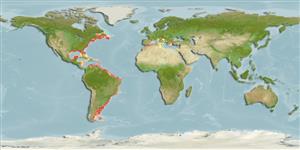
Benthic; saumâtre; profondeur 0 - 79 m (Réf. 83435). Subtropical, preferred 22°C (Réf. 107945); 51°N - 50°S, 98°W - 35°W
Western Atlantic: from Gulf of St. Lawrence, Canada to Tamaulipas, Mexico south to Argentina. Introduced in Northeast Atlantic, Mediterranean Sea and the Pacific Ocean.
Longueur à la première maturité / Taille / Poids / Âge
Maturité: Lm ? range ? - ? cm Max length : 35.5 cm SHL mâle / non sexé; (Réf. 96280); âge max. reporté: 2.00 années (Réf. 2823)
Description synthétique
Morphologie
Diagnostic features: Shell thick and heavy, usually narrow and elongate, but extremely variable in shape. Upper valve flatter, smaller than lower valve; lower valve convex. Shell shape and outline variable. Shell margins undulating straight. Umbones long and curved. Colour: dirty to light grey, internally white with muscle scar deep purple (Ref. 271).
Attached to rocks, other oyster shells, or other hard substrates (Ref. 271). Favors estuaries and embayments with low salinities and are intolerant of prolonged exposure to fresh water or marine conditions. They may either be filter feeders (Ref. 96280) or suspension feeders (Ref. 3248). Found in shallow water of tidal to subtidal depth of fairly constant turbidity and salinity (Ref. 3248) and salt marshes (Ref. 2823). Main sources of food are phytoplankton, suspended detritus particles (Ref. 96280) and bacteria (Ref. 101343). Able to regulate its feeding rates based on differences in size, type and composition of the food source (Ref. 96280).
Cycle de vie et comportement reproducteur
Maturité | Reproduction | Frai | Œufs | Fécondité | Larves
Gonochoristic (separate male and females). After external fertilization, the developing larvae or veliger settles to the bottom after a time in the plankton stage. First spawning usually occurs when oyster is two years of age (Ref. 3248).
Carpenter, K.E. (ed.) 2002 The living marine resources of the Western Central Atlantic. Volume 1: Introduction, molluscs, crustaceans, hagfishes, sharks, batoid fishes, and chimaeras. FAO Species Identification Guide for Fishery Purposes and American Society of Ichthyologists and Herpetologists Special Publication No. 5, Rome. 600p. (Réf. 271)
Statut dans la liste rouge de l'IUCN
(Réf. 130435: Version 2025-2 (Global))
statut CITES (Réf. 108899)
Not Evaluated
Not Evaluated
Menace pour l'homme
Utilisations par l'homme
Pêcheries: commercial; Aquaculture: commercial
FAO - Aquaculture Systems: Résumé espèce, production search; pêcheries: Résumé espèce, landings search; Publication: search | FishSource | Sea Around Us
Outils
Plus d'informations
Dynamique des populations PhysiologieConsommation d'oxygène
Liées à l'hommeTimbres, pièces de monnaie, divers
Sources Internet
Estimations basées sur des modèles
Rate of population increase
|
Prior r = 0.72, 95% CL = 0.47 - 1.07, Based on 1 full stock assessment. |
Vulnérabilité de la pêche
(Réf. 71543) |
Low to moderate vulnerability (27 of 100). |
Vulnérabilité climatique
(Réf. 125649) |
High vulnerability (57 of 100) |
Catégorie de prix
(Réf. 80766): |
Low. |
Nutrients
|
Calcium = 149 [71, 228] mg/100g; Iron = 8.53 [1.95, 15.11] mg/100g; Protein = 9.88 [8.64, 11.12] %; Omega3 = 0.313 [0.202, 0.423] g/100g; Selenium = 61 [50, 72] μg/100g; VitaminA = 0 μg/100g; Zinc = 2.04 [0.56, 3.51] mg/100g (wet weight); based on nutrient studies. |