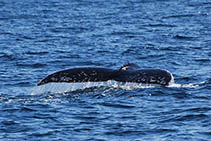
Mammalia |
Cetartiodactyla |
Eschrichtiidae
Environment: milieu / climate zone / depth range / distribution range
Ecology
Pelagic; oceanodromous (Ref. 75906); depth range 1 - 2500 m, usually 30 - 500 m. Tropical; 90°N - 0°S, 115°E - 105°W
Pacific Ocean, Atlantic Ocean and the Arctic: Extinct in North Atlantic; two populations in North Pacific. Tropical to polar. [western population: IUCN 2010 (Ref. 84930): CR, C2a(ii);E.]
Length at first maturity / Size / Weight / Age
Maturity: Lm 1,220.0 range ? - ? cm Max length : 1,500 cm TL male/unsexed; (Ref. 1394); max. published weight: 35.0 t (Ref. 1394); max. reported age: 48 years (Ref. 128170)
Lives within a few tens of kilometers of shore. Bottom feeders that feed primarily on swarming mysids and tube-dwelling amphipods in the northern parts of their range, but are also known to take red crabs, baitfish, and other food opportunistically. The North Atlantic stock was apparently wiped-out by whalers in the 18th century. A western North Pacific (Korean) stock may also have been extirpated in the mid 20th century; its continued existence as a small remnant is still debated. The eastern North Pacific (California-Chukotka) stock nearly suffered the same fate twice, once in the late 1800s and again in the early 1900s. Both times, a respite in commercial whaling allowed the population to recover. About 170 to 200 from this latter stock are killed annually under special permit by commercial whalers on behalf of Soviet aborigines, and one or a few are taken in some years by Alaskan Eskimos. Since receiving IWC protection in 1946 and the end of research harvests in the late 1960s this population has increased, and now apparently equals or exceeds pre-exploitation numbers (Ref. 1394). Lives within a few tens of kilometers of shore. Bottom feeders that feed primarily on swarming mysids and tube-dwelling amphipods in the northern parts of their range, but are also known to take red crabs, baitfish, and other food opportunistically (Ref. 1394).
Life cycle and mating behavior
Maturity | Reproduction | Spawning | Eggs | Fecundity | Larvae
Jefferson, T.A., S. Leatherwood and M.A. Webber 1993 FAO species Identification Guide: Marine Mammals of the World. Rome, FAO. 320 p. + 587 figures. (Ref. 1394)
IUCN Red List Status
(Ref. 130435: Version 2025-2 (Global))
CITES status (Ref. 108899)
Not Evaluated
Threat to humans
Human uses
Fisheries: commercial
FAO - Fisheries: species profile, landings search; Publication: search | FishSource | Sea Around Us
Tools
More information
PhysiologyOxygen consumption
Human RelatedStamps, coins, misc.
Internet sources
Estimates based on models
Resilience
(Ref. 69278): |
Medium, minimum population doubling time 1.4 - 4.4 years (K=0.19-0.25; tm=8; tmax=48) |
Fishing Vulnerability
(Ref. 71543) |
Very high vulnerability (79 of 100). |
Price category
(Ref. 80766): |
Unknown. |