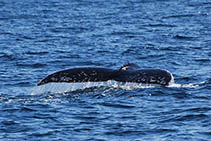
Mammalia |
Cetartiodactyla |
Eschrichtiidae
Entorno: milieu / zona climática / rango de profundidad / gama de distribución
Ecología
Pelágico; oceanodromo (Referencia 75906); rango de profundidad 1 - 2500 m, usually 30 - 500 m. Tropical; 90°N - 0°S, 115°E - 105°W
Pacific Ocean, Atlantic Ocean and the Arctic: Extinct in North Atlantic; two populations in North Pacific. Tropical to polar. [western population: IUCN 2010 (Ref. 84930): CR, C2a(ii);E.]
Longitud en la primera madurez / Tamaño / Peso / Edad
Madurez: Lm 1,220.0 range ? - ? cm Max length : 1,500 cm TL macho / no sexado; (Referencia 1394); peso máximo publicado: 35.0 t (Referencia 1394); edad máxima reportada: 48 años (Referencia 128170)
Lives within a few tens of kilometers of shore. Bottom feeders that feed primarily on swarming mysids and tube-dwelling amphipods in the northern parts of their range, but are also known to take red crabs, baitfish, and other food opportunistically. The North Atlantic stock was apparently wiped-out by whalers in the 18th century. A western North Pacific (Korean) stock may also have been extirpated in the mid 20th century; its continued existence as a small remnant is still debated. The eastern North Pacific (California-Chukotka) stock nearly suffered the same fate twice, once in the late 1800s and again in the early 1900s. Both times, a respite in commercial whaling allowed the population to recover. About 170 to 200 from this latter stock are killed annually under special permit by commercial whalers on behalf of Soviet aborigines, and one or a few are taken in some years by Alaskan Eskimos. Since receiving IWC protection in 1946 and the end of research harvests in the late 1960s this population has increased, and now apparently equals or exceeds pre-exploitation numbers (Ref. 1394). Lives within a few tens of kilometers of shore. Bottom feeders that feed primarily on swarming mysids and tube-dwelling amphipods in the northern parts of their range, but are also known to take red crabs, baitfish, and other food opportunistically (Ref. 1394).
Ciclo vital y comportamiento de apareamiento
Madurez | Reproducción | Puesta | Huevos | Fecundidad | Larva
Jefferson, T.A., S. Leatherwood and M.A. Webber 1993 FAO species Identification Guide: Marine Mammals of the World. Rome, FAO. 320 p. + 587 figures. (Referencia 1394)
Situación en la Lista Roja de la UICN
(Referencia 130435: Version 2025-2 (Global))
Estatus CITES (Referencia 108899)
CMS (Referencia 116361)
Not Evaluated
Amenaza para el ser humano
Usos humanos
Pesquerías: comercial
FAO - pesquerías: perfil de la especie, landings search; Publication: search | FishSource | Sea Around Us
Herramientas
Más información
FisiologíaConsumo del oxígeno
Relacionados con el ser humanoSellos, monedas, varios
Fuentes de Internet
Estimaciones basadas en modelos
Resiliencia
(Ref. 69278): |
Medio, población duplicada en un tiempo mínimo de 1.4-4.4 años (K=0.19-0.25; tm=8; tmax=48) |
Vulnerabilidad pesquera
(Referencia 71543) |
Very high vulnerability (79 of 100). |
Categoría de precios
(Referencia 80766): |
Unknown. |