Malacostraca |
Decapoda |
Nephropidae
Environnement : milieu / zone climatique / profondeur / gamme de distribution
Écologie
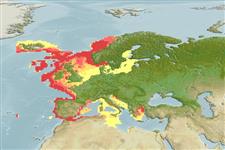
Benthic; profondeur 20 - 800 m (Réf. 441), usually 200 - 600 m (Réf. 88009). Temperate, preferred 16°C (Réf. 107945); 72°N - 27°N, 25°W - 27°E
Eastern Atlantic and the Mediterranean: From Finnmark, Norway south to Libya west to the Canary Is. and east to Aegean Sea. Subtropical to polar.
Longueur à la première maturité / Taille / Poids / Âge
Maturité: Lm 3.2, range 2 - 5.5 cm Max length : 24.0 cm BL mâle / non sexé; (Réf. 441); common length : 19.0 cm BL mâle / non sexé; (Réf. 441)
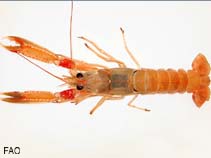
Total body length: 8 to 24 cm, usually between 10 to 20 cm (Ref. 4). Found in the continental shelf and slope (Ref. 94799). Epibenthic (Ref. 87524). Sedentary (Ref. 94799). Inhabits muddy bottoms in which it digs its burrows. Nocturnal and feeds on detritus, crustaceans and worms (Ref. 4). An active predator or scavenger (Ref. 94757). Another isotope data (δ15N=6.26±0.14, n=3, Ref. 106518).
Ovigerous females are found practically throughout the year, the eggs laid around July are carried for about 9 months (Ref. 4). 1 brood per year (Ref. 81133); 1.6 cm postlarval size (Ref. 81161); 1 month of pelagic period (Ref. 81160).
Holthuis, L.B. 1991 FAO Species Catalogue. Vol. 13. Marine lobsters of the world. An annotated and illustrated catalogue of species of interest to fisheries known to date. FAO Fish. Synop. 125(13):292p. Rome: FAO. (Réf. 4)
Statut dans la liste rouge de l'IUCN
(Réf. 130435: Version 2025-2 (Global))
statut CITES (Réf. 108899)
Not Evaluated
Not Evaluated
Menace pour l'homme
Utilisations par l'homme
Pêcheries: commercial
FAO - pêcheries: Résumé espèce, landings search; Publication: search | FIRMS (Stock assessments) | FishSource | Sea Around Us
Outils
Plus d'informations
Dynamique des populations Liées à l'hommeTimbres, pièces de monnaie, divers
Sources Internet
Estimations basées sur des modèles
Résilience
(Ref. 69278): |
Milieu, temps minimum de doublement de population : 1,4 à 4,4 années (K=0.03-0.44; tm=2) |
Rate of population increase
|
Prior r = 0.50, 95% CL = 0.33 - 0.75, Based on 36 full stock assessments. |
Vulnérabilité de la pêche
(Réf. 71543) |
Moderate vulnerability (41 of 100). |
Vulnérabilité climatique
(Réf. 125649) |
Low to moderate vulnerability (29 of 100) |
Catégorie de prix
(Réf. 80766): |
Very high. |
Nutrients
|
Calcium = 109 [35, 184] mg/100g; Iron = 1.59 [1.21, 1.97] mg/100g; Protein = 20.2 [19.2, 21.3] %; Omega3 = 0.285 [0.185, 0.386] g/100g; Selenium = 48.3 [-31.7, 128.3] μg/100g; VitaminA = 0 μg/100g; Zinc = 1.79 [1.17, 2.40] mg/100g (wet weight); based on nutrient studies. |