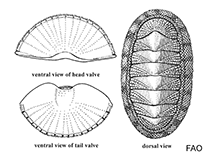
Polyplacophora |
Chitonida |
Chitonidae
Umwelt: Milieu / Klimazone / Tiefenbereich / Verbreitungsgebiet
Ökologie
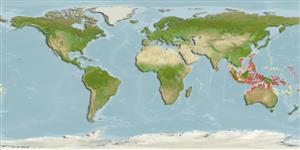
Benthic. Tropical; 22°S - 27°N, 117°E - 169°E
Indo-West Pacific.
Länge bei der ersten Reifung / Größe / Gewicht / Alter
Geschlechtsreife: Lm ? range ? - ? cm Max length : 9.0 cm BL Männchen/unbestimmt; (Ref. 83505)
Maximum length is based on data from Australia (Ref. 83505). Seeks shelter within crevices during low tide (Ref. 101383). Associated with Saccostrea cucculata (Ref. 2919).
Lebenszyklus und Paarungsverhalten
Geschlechtsreife | Fortpflanzung | Ablaichen | Eier | Fruchtbarkeit | Larven
Members of the class Polyplacophora are mostly gonochoric. Life cycle: Eggs hatch into lecitotrophic planktonic trocophore larvae (no veliger stage) which later metamorphose and settle on the bottom as young adults.
Schwabe, E. 2006 On a Small collection of Chitons from Papua New guinea (Mollusca: Polyplacophora). Venus 65 (1 and 2):97-112. (Ref. 2030)
IUCN Rote Liste Status
(Ref. 130435: Version 2025-2 (Global))
CITES Status (Ref. 108899)
Not Evaluated
Not Evaluated
Bedrohung für Menschen
Harmless
Nutzung durch Menschen
Fischereien: kommerziell
FAO - Publication: search | FishSource | Das Meer um uns herum
Tools
Mehr Information
PopulationsdynamikWachstumMax. Alter/GrößenLänge-Gewicht-Rel.Länge-Länge-Verhältnis.LängenhäufigkeitenMassenkonvertierungDichte LebenszyklusFortpflanzungGeschlechtsreifeFruchtbarkeitAblaichenEierEientwicklungLarven PhysiologieSauerstoffverbrauch
MenschenbezogenBriefmarken, Münzen, Verschiedenes.
Internet Quellen
Schätzungen auf der Grundlage von Modellen
Anfälligkeit der Fischerei
(Ref. 71543) |
Low vulnerability (10 of 100). |
Preiskategorie
(Ref. 80766): |
Unknown. |
Nutrients
|
Calcium = 126 [75, 177] mg/100g; Iron = 4.79 [1.67, 7.92] mg/100g; Protein = 16.6 [15.4, 17.8] %; Omega3 = 0.331 [0.263, 0.400] g/100g; Selenium = 57.8 [48.5, 67.2] μg/100g; VitaminA = 0 μg/100g; Zinc = 1.97 [0.92, 3.02] mg/100g (wet weight); based on nutrient studies. |