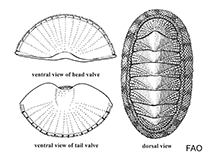
Polyplacophora |
Chitonida |
Chitonidae
Milieu: milieu / Klimaatzone / Diepte / verspreidingsgebied
Ecologie
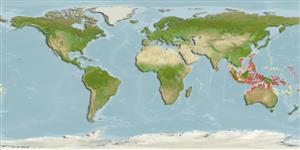
Benthic. Tropical; 22°S - 27°N, 117°E - 169°E
Indo-West Pacific.
Lengte bij maturiteit / Grootte / Gewicht / Leeftijd
Maturiteit: Lm ? range ? - ? cm Max length : 9.0 cm BL mannelijk / geslacht onbekend; (Ref. 83505)
Maximum length is based on data from Australia (Ref. 83505). Seeks shelter within crevices during low tide (Ref. 101383). Associated with Saccostrea cucculata (Ref. 2919).
Levenscyclus en paargedrag
Maturiteit | Voortplanting | Paaien | Eieren | Fecunditeit | Larven
Members of the class Polyplacophora are mostly gonochoric. Life cycle: Eggs hatch into lecitotrophic planktonic trocophore larvae (no veliger stage) which later metamorphose and settle on the bottom as young adults.
Schwabe, E. 2006 On a Small collection of Chitons from Papua New guinea (Mollusca: Polyplacophora). Venus 65 (1 and 2):97-112. (Ref. 2030)
Status op de Rode Lijst van het IUCN
(Ref. 130435: Version 2025-2 (Global))
CITES status (Ref. 108899)
Not Evaluated
Not Evaluated
Gevaar voor de mens
Harmless
Gebruik door de mens
Visserij: commercieel
FAO - Publication: search | FishSource | Sea Around Us
Tools
Meer informatie
LevenscyclusVoortplantingMaturiteitFecunditeitPaaienEierenOntwikkeling van de eierenLarven FysiologieZuurstofverbruik
Menselijk gerelateerdPostzegels, munten, diversen.
Internetbronnen
Schattingen op basis van modellen
Kwetsbaarheid van de visserij
(Ref. 71543) |
Low vulnerability (10 of 100). |
Prijsklasse
(Ref. 80766): |
Unknown. |
Nutrients
|
Calcium = 126 [75, 177] mg/100g; Iron = 4.79 [1.67, 7.92] mg/100g; Protein = 16.6 [15.4, 17.8] %; Omega3 = 0.331 [0.263, 0.400] g/100g; Selenium = 57.8 [48.5, 67.2] μg/100g; VitaminA = 0 μg/100g; Zinc = 1.97 [0.92, 3.02] mg/100g (wet weight); based on nutrient studies. |