Polyplacophora |
Chitonida |
Chitonidae
Environnement : milieu / zone climatique / profondeur / gamme de distribution
Écologie
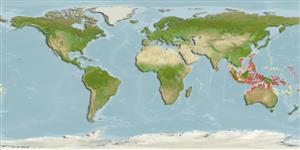
Benthic. Tropical; 22°S - 27°N, 117°E - 169°E
Indo-West Pacific.
Longueur à la première maturité / Taille / Poids / Âge
Maturité: Lm ? range ? - ? cm Max length : 9.0 cm BL mâle / non sexé; (Réf. 83505)
Maximum length is based on data from Australia (Ref. 83505). Seeks shelter within crevices during low tide (Ref. 101383). Associated with Saccostrea cucculata (Ref. 2919).
Cycle de vie et comportement reproducteur
Maturité | Reproduction | Frai | Œufs | Fécondité | Larves
Members of the class Polyplacophora are mostly gonochoric. Life cycle: Eggs hatch into lecitotrophic planktonic trocophore larvae (no veliger stage) which later metamorphose and settle on the bottom as young adults.
Schwabe, E. 2006 On a Small collection of Chitons from Papua New guinea (Mollusca: Polyplacophora). Venus 65 (1 and 2):97-112. (Réf. 2030)
Statut dans la liste rouge de l'IUCN
(Réf. 130435: Version 2025-2 (Global))
statut CITES (Réf. 108899)
Not Evaluated
Not Evaluated
Menace pour l'homme
Harmless
Utilisations par l'homme
Pêcheries: commercial
FAO - Publication: search | FishSource | Sea Around Us
Outils
Plus d'informations
Dynamique des populationsCroissanceÂges / tailles maximalesLongueur-poids rel.Rel. longueur-longueur.Fréquences de longueursConversion de masseAbondance Cycle de vieReproductionMaturitéFéconditéFraiŒufsDéveloppement de l'œufLarves PhysiologieConsommation d'oxygène
Liées à l'hommeTimbres, pièces de monnaie, divers
Sources Internet
Estimations basées sur des modèles
Vulnérabilité de la pêche
(Réf. 71543) |
Low vulnerability (10 of 100). |
Catégorie de prix
(Réf. 80766): |
Unknown. |
Nutrients
|
Calcium = 126 [75, 177] mg/100g; Iron = 4.79 [1.67, 7.92] mg/100g; Protein = 16.6 [15.4, 17.8] %; Omega3 = 0.331 [0.263, 0.400] g/100g; Selenium = 57.8 [48.5, 67.2] μg/100g; VitaminA = 0 μg/100g; Zinc = 1.97 [0.92, 3.02] mg/100g (wet weight); based on nutrient studies. |