Bivalvia |
Venerida |
Veneridae
环境:氛围 / 气候带 / 深度上下限 / 分布范围
生态学
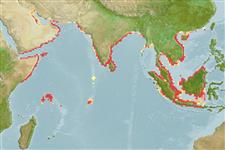
Benthic; 半咸淡水; 深度上下限 0 - 20 m (参考文献 348). Tropical; 31°N - 9°S, 44°E - 118°E
Indo-Pacific: from northwest Indian Ocean and the Aden Gulf to Indonesia.
首次成熟时的长度 / 大小 / 重量 / 年龄
成熟度: Lm ? range ? - ? cm Max length : 6.5 cm SHL 雄鱼/尚未辨别雌雄; (参考文献 348); common length : 5.0 cm SHL 雄鱼/尚未辨别雌雄; (参考文献 348); 最大年龄: 3.00 年 (参考文献 8702)
Depth range is based on ecology (Ref. 348); to be replaced wtith a better reference. Primarily marine but also invades backwaters and estuaries (Ref. 105059). Found in protected coastal areas, with shallow subtidal waters (Ref. 348). In muddy and sandy substrates (Ref. 105057) where it burrows (Ref. 105059). Family is known to be suspension feeders, filtering planktonic algae and organic matter from the water (Ref. 348).
生命周期和交配行为
成熟度 | 繁殖 | 产卵场 | 卵 | 孕卵数 | 仔鱼
Members of the class Bivalvia are mostly gonochoric, some are protandric hermaphrodites. Life cycle: Embryos develop into free-swimming trocophore larvae, succeeded by the bivalve veliger, resembling a miniature clam.
主要参考文献
参考文献 | 合作者 | 合作者
Poutiers, J.M. 1998 Bivalves. Acephala, Lamellibranchia, Pelecypoda. p. 123-362. In Carpenter, K. E. and V. H. Niem. 1998. FAO species identification guide for fishery purposes. The living marine resources of the Western Central Pacific. Volume 1. Seaweeds, corals, bivalves, and gastropods. Rome, FAO. (参考文献 348)
世界自然保护联盟红皮书
(参考文献 130435: Version 2025-2 (Global))
Not Evaluated
Not Evaluated
对人类的威胁
Harmless
人类利用
FAO - Publication: search | FishSource |
工具
网络资源
基于模型的估算