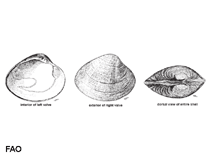
Bivalvia |
Venerida |
Veneridae
Lingkungan: lingkungan / zona iklim / kisaran kedalaman / jangkauan distribusi
Ekologi
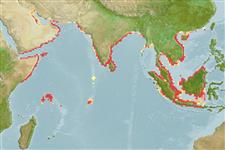
Benthic; payau; kisaran kedalaman 0 - 20 m (Acuan 348). Tropical; 31°N - 9°S, 44°E - 118°E
Indo-Pacific: from northwest Indian Ocean and the Aden Gulf to Indonesia.
Panjang pada saat jatuh tempo pertama / Ukuran / Berat / umur
Kematangan: Lm ? range ? - ? cm Max length : 6.5 cm SHL jantan/; (Acuan 348); common length : 5.0 cm SHL jantan/; (Acuan 348); Umur maksimum dilaporkan: 3.00 Tahun (Acuan 8702)
Depth range is based on ecology (Ref. 348); to be replaced wtith a better reference. Primarily marine but also invades backwaters and estuaries (Ref. 105059). Found in protected coastal areas, with shallow subtidal waters (Ref. 348). In muddy and sandy substrates (Ref. 105057) where it burrows (Ref. 105059). Family is known to be suspension feeders, filtering planktonic algae and organic matter from the water (Ref. 348).
Siklus hidup dan perilaku kawin
Kematangan | Reproduksi, perkembang biakan | Pemijahan | telur-telur | Fekunditas | Larva
Members of the class Bivalvia are mostly gonochoric, some are protandric hermaphrodites. Life cycle: Embryos develop into free-swimming trocophore larvae, succeeded by the bivalve veliger, resembling a miniature clam.
rujukan utama
Acuan | Koordinator | mitra
Poutiers, J.M. 1998 Bivalves. Acephala, Lamellibranchia, Pelecypoda. p. 123-362. In Carpenter, K. E. and V. H. Niem. 1998. FAO species identification guide for fishery purposes. The living marine resources of the Western Central Pacific. Volume 1. Seaweeds, corals, bivalves, and gastropods. Rome, FAO. (Acuan 348)
Status IUCN Red List
(Acuan 130435: Version 2025-2 (Global))
status CITES (Acuan 108899)
Not Evaluated
Not Evaluated
ancaman kepada manusia
Harmless
penggunaan manusia
FAO - Publication: search | FishSource |
Alat, peralatan
informasi lanjut
Dinamika populasiPertumbuhanMaks. usia / ukuranPanjang-berat rel.Panjang-panjang rel.ukuran frekuensiKonversi massaKelimpahan FisiologiKonsumsi oksigen
Yang berhubungan dengan manusiaPerangko, koin, dll.
Sumber internet
Estimasi berdasarkan model
Kerentanan Penangkapan Ikan
(Acuan 71543) |
Low vulnerability (16 of 100). |
kategori harga
(Acuan 80766): |
Medium. |