Malacostraca |
Decapoda |
Geryonidae
Ambiente: milieu / zona climatica / distribuzione batimetrica / gamma di distribuzione
Ecologia
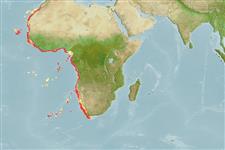
Benthic; distribuzione batimetrica 100 - 950 m (Fonte Biblio. 804), usually 300 - 700 m (Fonte Biblio. 435). Tropical; 31°N - 36°S, 26°W - 21°E
Eastern Atlantic: West to southwest Africa.
Lunghezza alla prima maturità / Dimensione / Peso / Età
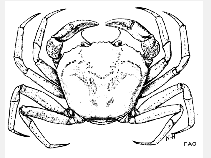
Maturità: Lm ?, range 8 - 10 cm Max length : 16.0 cm CW maschio/sesso non determinato; (Fonte Biblio. 435); 9.5 cm CW (female)
Inhabits muddy bottoms at depths of 100 to 936 m, common between 300 to 700 m (Ref. 435). Also in muddy-sandy bottoms (Ref. 101384). Tends to aggregate in areas near canyons and other bottom features (Ref. 2677). In general, adult geryonid crabs are opportunistic feeders (Ref. 104380).
Ciclo vitale e comportamento di accoppiamento
Maturità | Riproduzione | Deposizione | Uova | Fecondità | Larve
Mating behavior: Newly moulted or soft-shelled female is carried by the male with its pleopods
Fischer, W., G. Bianchi and W.B. Scott (eds.) 1981 True Crabs. 6: pag.var. In FAO species identification sheets for fishery purposes. Eastern Central Atlantic (fishing areas 34, 47; in part). Canada Funds-in-Trust. Ottawa, Department of Fisheries and Oceans Canada, by arrangement with the Food and AgriculturesOrganization of the United Nations, 1-7: pag.var. (Fonte Biblio. 435)
Stato della Lista Rossa IUCN
(Fonte Biblio. 130435: Version 2025-2 (Global))
Stato della CITES (Fonte Biblio. 108899)
Not Evaluated
CMS (Fonte Biblio. 116361)
Not Evaluated
Minaccia per l'uomo
Harmless
Usi umani
Pesca: commerciale
FAO - Publication: search | FishSource | Sea Around Us
Strumenti
Informazioni ulteriori
Ecologia troficaArticoli alimentari (prede)
Alimentazione
Consumo di cibo
Predatori
Dinamica della popolazione FisiologiaConsumo di ossigeno
Legato all'uomoFrancobolli, monete, materiale vario.
Fonti Internet
Stime basate su modelli
Rate of population increase
|
Prior r = 0.42, 95% CL = 0.28 - 0.63, Based on 1 data-limited stock assessment. |
Vulnerabilità della pesca
(Fonte Biblio. 71543) |
Low vulnerability (10 of 100). |
Categoria di prezzo
(Fonte Biblio. 80766): |
Very high. |
Nutrients
|
Calcium = 109 [35, 184] mg/100g; Iron = 1.59 [1.21, 1.97] mg/100g; Protein = 20.2 [19.2, 21.3] %; Omega3 = 0.285 [0.185, 0.386] g/100g; Selenium = 48.3 [-31.7, 128.3] μg/100g; VitaminA = 0 μg/100g; Zinc = 1.79 [1.17, 2.40] mg/100g (wet weight); based on nutrient studies. |