Malacostraca |
Decapoda |
Geryonidae
Milieu: milieu / Klimaatzone / Diepte / verspreidingsgebied
Ecologie
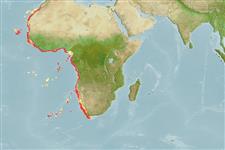
Benthic; diepte 100 - 950 m (Ref. 804), usually 300 - 700 m (Ref. 435). Tropical; 31°N - 36°S, 26°W - 21°E
Eastern Atlantic: West to southwest Africa.
Lengte bij maturiteit / Grootte / Gewicht / Leeftijd
Maturiteit: Lm ?, range 8 - 10 cm Max length : 16.0 cm CW mannelijk / geslacht onbekend; (Ref. 435); 9.5 cm CW (female)
Inhabits muddy bottoms at depths of 100 to 936 m, common between 300 to 700 m (Ref. 435). Also in muddy-sandy bottoms (Ref. 101384). Tends to aggregate in areas near canyons and other bottom features (Ref. 2677). In general, adult geryonid crabs are opportunistic feeders (Ref. 104380).
Mating behavior: Newly moulted or soft-shelled female is carried by the male with its pleopods
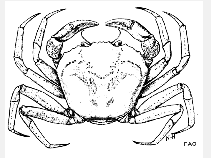
Fischer, W., G. Bianchi and W.B. Scott (eds.) 1981 True Crabs. 6: pag.var. In FAO species identification sheets for fishery purposes. Eastern Central Atlantic (fishing areas 34, 47; in part). Canada Funds-in-Trust. Ottawa, Department of Fisheries and Oceans Canada, by arrangement with the Food and AgriculturesOrganization of the United Nations, 1-7: pag.var. (Ref. 435)
Status op de Rode Lijst van het IUCN
(Ref. 130435: Version 2025-2 (Global))
CITES status (Ref. 108899)
Not Evaluated
Not Evaluated
Gevaar voor de mens
Harmless
Gebruik door de mens
Visserij: commercieel
FAO - Publication: search | FishSource | Sea Around Us
Tools
Meer informatie
Trofische ecologieVoedsel (prooien)
Dieetsamenstelling
Voedselconsumptie
Predatoren
FysiologieZuurstofverbruik
Menselijk gerelateerdPostzegels, munten, diversen.
Internetbronnen
Schattingen op basis van modellen
Rate of population increase
|
Prior r = 0.42, 95% CL = 0.28 - 0.63, Based on 1 data-limited stock assessment. |
Kwetsbaarheid van de visserij
(Ref. 71543) |
Low vulnerability (10 of 100). |
Prijsklasse
(Ref. 80766): |
Very high. |
Nutrients
|
Calcium = 109 [35, 184] mg/100g; Iron = 1.59 [1.21, 1.97] mg/100g; Protein = 20.2 [19.2, 21.3] %; Omega3 = 0.285 [0.185, 0.386] g/100g; Selenium = 48.3 [-31.7, 128.3] μg/100g; VitaminA = 0 μg/100g; Zinc = 1.79 [1.17, 2.40] mg/100g (wet weight); based on nutrient studies. |