Malacostraca |
Decapoda |
Geryonidae
Environnement : milieu / zone climatique / profondeur / gamme de distribution
Écologie
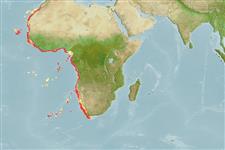
Benthic; profondeur 100 - 950 m (Réf. 804), usually 300 - 700 m (Réf. 435). Tropical; 31°N - 36°S, 26°W - 21°E
Eastern Atlantic: West to southwest Africa.
Longueur à la première maturité / Taille / Poids / Âge
Maturité: Lm ?, range 8 - 10 cm Max length : 16.0 cm CW mâle / non sexé; (Réf. 435); 9.5 cm CW (female)
Inhabits muddy bottoms at depths of 100 to 936 m, common between 300 to 700 m (Ref. 435). Also in muddy-sandy bottoms (Ref. 101384). Tends to aggregate in areas near canyons and other bottom features (Ref. 2677). In general, adult geryonid crabs are opportunistic feeders (Ref. 104380).
Cycle de vie et comportement reproducteur
Maturité | Reproduction | Frai | Œufs | Fécondité | Larves
Mating behavior: Newly moulted or soft-shelled female is carried by the male with its pleopods
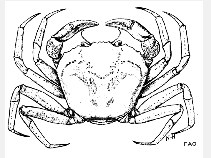
Fischer, W., G. Bianchi and W.B. Scott (eds.) 1981 True Crabs. 6: pag.var. In FAO species identification sheets for fishery purposes. Eastern Central Atlantic (fishing areas 34, 47; in part). Canada Funds-in-Trust. Ottawa, Department of Fisheries and Oceans Canada, by arrangement with the Food and AgriculturesOrganization of the United Nations, 1-7: pag.var. (Réf. 435)
Statut dans la liste rouge de l'IUCN
(Réf. 130435: Version 2025-2 (Global))
statut CITES (Réf. 108899)
Not Evaluated
Not Evaluated
Menace pour l'homme
Harmless
Utilisations par l'homme
Pêcheries: commercial
FAO - Publication: search | FishSource | Sea Around Us
Outils
Plus d'informations
Écologie trophiqueAliments (proies)
Composition du régime alimentaire
Consommation alimentaire
Prédateurs
Dynamique des populationsCroissanceÂges / tailles maximalesLongueur-poids rel.Rel. longueur-longueur.Fréquences de longueursConversion de masseAbondance PhysiologieConsommation d'oxygène
Liées à l'hommeTimbres, pièces de monnaie, divers
Sources Internet
Estimations basées sur des modèles
Rate of population increase
|
Prior r = 0.42, 95% CL = 0.28 - 0.63, Based on 1 data-limited stock assessment. |
Vulnérabilité de la pêche
(Réf. 71543) |
Low vulnerability (10 of 100). |
Catégorie de prix
(Réf. 80766): |
Very high. |
Nutrients
|
Calcium = 109 [35, 184] mg/100g; Iron = 1.59 [1.21, 1.97] mg/100g; Protein = 20.2 [19.2, 21.3] %; Omega3 = 0.285 [0.185, 0.386] g/100g; Selenium = 48.3 [-31.7, 128.3] μg/100g; VitaminA = 0 μg/100g; Zinc = 1.79 [1.17, 2.40] mg/100g (wet weight); based on nutrient studies. |