Bivalvia |
Mytilida |
Mytilidae
สิ่งแวดล้อม : สิ่งแวดล้อม / เขตภูมิอากาศ / ระดับความลึก / ระยะการกระจายสินค้า
นิเวศวิทยา
Benthic. Tropical
Indo-West Pacific: from northwest Indian Ocean, including the Red Sea, to Indonesia; north to Vietnam and south to New Caledonia. Exact distribution of this species is not known, because of confusions with other related mytilid species.
ความยาวเมื่อครบกำหนดครั้งแรก / ขนาด / น้ำหนัก / อายุ
วัยเจริญพันธุ์: Lm ? range ? - ? cm Max length : 5.0 cm TL เพศผู้/กระเทย; (อ้างอิง 348); common length : 3.0 cm TL เพศผู้/กระเทย; (อ้างอิง 348); อายุสูงสุดที่ได้รายงาน: 2.00 ปี (อ้างอิง 8702)
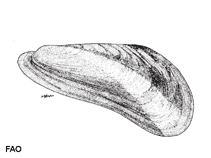
Shell rather small, thin and fragile, somewhat translucent, roughly elongate trapeziform in outline, with very long and rather narrow shape. Anterior margin of valves quite short and sharply rounded, clearly extending forwards beyond the umbones. Ventral margin very long and broadly concave medially. A broad and rounded keel, radiating obliquely towards posteroventral end of valves and bordered anteriorly by a wide and shallow depression determining the sinuation of ventral margin. Outer surface of valves smoothish with only fine concentric growth lines and a few small radial grooves in front of the umbones. Periostracum smooth and shiny, translucent, closely applied to shell surface. Hinge line with very small crenulations, mainly appearing behind the ligamental margin. Anterior adductor scar present. Internal margins very thin and smooth, undulate anteriorly in relation to the outer radial sculpture. Colour: outer coloration variable, light tan to olive-green or brown, often paler on the keel, with a median radial band and sometimes irregular transverse stripes of purplish brown on posterodorsal slope. Interior slightly pearly, pale bluish grey with the outer colour pattern showing through.
On soft bottoms, often occurring gregariously. Intertidal and shallow subtidal waters (Ref. 348).
วงจรชีวิตและพฤติกรรมการผสมพันธุ์
วัยเจริญพันธุ์ | การสืบพันธุ์ | การวางไข่ | เซลสืบพันธ์ของเพศเมีย(ไข่) | ความดกของไข่ | ตัวอ่อน
Members of the class Bivalvia are mostly gonochoric, some are protandric hermaphrodites. Life cycle: Embryos develop into free-swimming trocophore larvae, succeeded by the bivalve veliger, resembling a miniature clam.
Poutiers, J.M. 1998 Bivalves. Acephala, Lamellibranchia, Pelecypoda. p. 123-362. In Carpenter, K. E. and V. H. Niem. 1998. FAO species identification guide for fishery purposes. The living marine resources of the Western Central Pacific. Volume 1. Seaweeds, corals, bivalves, and gastropods. Rome, FAO. (อ้างอิง 348)
สถานะบัญชีแดงของ IUCN
(อ้างอิง 130435: Version 2025-2 (Global))
สถานะไซเตส (อ้างอิง 108899)
Not Evaluated
CMS (อ้างอิง 116361)
Not Evaluated
ภัยคุกคามต่อมนุษย์
Harmless
การใช้ของมนุษย์
FAO - Publication: search | FishSource |
เครื่องมือ
ข้อมูลเพิ่มเติม
นิเวศวิทยาเขตร้อนรายการอาหาร (เหยื่อ)
องค์ประอบของอาหาร
การบริโภคอาหาร
ผู้ล่า
วงจรชีวิตการสืบพันธุ์วัยเจริญพันธุ์ความดกของไข่การวางไข่เซลสืบพันธ์ของเพศเมีย(ไข่)การพัฒนาไข่ตัวอ่อน เกี่ยวข้องกับมนุษย์แสตมป์ เหรียญ อื่นๆ
แหล่งที่มาจากอินเตอร์เน็ต
การประมาณค่าตามแบบจำลอง
ความสามารถในการกลับคืนสู่ปกติ
(Ref. 69278): |
ความสูง, เวลาต่ำสุดที่จะทำให้ประชากรเพิ่มขึ้นเป็น 2 เท่าใช้เวลาน้อยกว่า 15 เดือน (K=1.2; tmax=2) |
ความเสี่ยงต่อการตกปลา
(อ้างอิง 71543) |
Low vulnerability (10 of 100). |
หมวดหมู่ราคา
(อ้างอิง 80766): |
Medium. |