Bivalvia |
Mytilida |
Mytilidae
Umwelt: Milieu / Klimazone / Tiefenbereich / Verbreitungsgebiet
Ökologie
Benthic. Tropical
Indo-West Pacific: from northwest Indian Ocean, including the Red Sea, to Indonesia; north to Vietnam and south to New Caledonia. Exact distribution of this species is not known, because of confusions with other related mytilid species.
Länge bei der ersten Reifung / Größe / Gewicht / Alter
Geschlechtsreife: Lm ? range ? - ? cm Max length : 5.0 cm TL Männchen/unbestimmt; (Ref. 348); common length : 3.0 cm TL Männchen/unbestimmt; (Ref. 348); max. veröff. Alter: 2.00 Jahre (Ref. 8702)
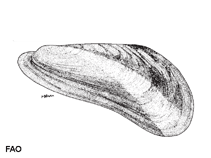
Shell rather small, thin and fragile, somewhat translucent, roughly elongate trapeziform in outline, with very long and rather narrow shape. Anterior margin of valves quite short and sharply rounded, clearly extending forwards beyond the umbones. Ventral margin very long and broadly concave medially. A broad and rounded keel, radiating obliquely towards posteroventral end of valves and bordered anteriorly by a wide and shallow depression determining the sinuation of ventral margin. Outer surface of valves smoothish with only fine concentric growth lines and a few small radial grooves in front of the umbones. Periostracum smooth and shiny, translucent, closely applied to shell surface. Hinge line with very small crenulations, mainly appearing behind the ligamental margin. Anterior adductor scar present. Internal margins very thin and smooth, undulate anteriorly in relation to the outer radial sculpture. Colour: outer coloration variable, light tan to olive-green or brown, often paler on the keel, with a median radial band and sometimes irregular transverse stripes of purplish brown on posterodorsal slope. Interior slightly pearly, pale bluish grey with the outer colour pattern showing through.
On soft bottoms, often occurring gregariously. Intertidal and shallow subtidal waters (Ref. 348).
Lebenszyklus und Paarungsverhalten
Geschlechtsreife | Fortpflanzung | Ablaichen | Eier | Fruchtbarkeit | Larven
Members of the class Bivalvia are mostly gonochoric, some are protandric hermaphrodites. Life cycle: Embryos develop into free-swimming trocophore larvae, succeeded by the bivalve veliger, resembling a miniature clam.
Poutiers, J.M. 1998 Bivalves. Acephala, Lamellibranchia, Pelecypoda. p. 123-362. In Carpenter, K. E. and V. H. Niem. 1998. FAO species identification guide for fishery purposes. The living marine resources of the Western Central Pacific. Volume 1. Seaweeds, corals, bivalves, and gastropods. Rome, FAO. (Ref. 348)
IUCN Rote Liste Status
(Ref. 130435: Version 2025-2 (Global))
CITES Status (Ref. 108899)
Not Evaluated
Not Evaluated
Bedrohung für Menschen
Harmless
Nutzung durch Menschen
FAO - Publication: search | FishSource |
Tools
Mehr Information
Trophische ÖkologieLebensmittel (Beutetiere)
Nahrungszusammensetzung
Nahrungsaufnahme
Räuber
LebenszyklusFortpflanzungGeschlechtsreifeFruchtbarkeitAblaichenEierEientwicklungLarven PhysiologieSauerstoffverbrauch
MenschenbezogenBriefmarken, Münzen, Verschiedenes.
Internet Quellen
Schätzungen auf der Grundlage von Modellen
Widerstandsfähigkeit
(Ref. 69278): |
hoch, Verdopplung der Population dauert weniger als 15 Monate. (K=1.2; tmax=2) |
Anfälligkeit der Fischerei
(Ref. 71543) |
Low vulnerability (10 of 100). |
Preiskategorie
(Ref. 80766): |
Medium. |