Bivalvia |
Mytilida |
Mytilidae
Окружающая среда: среда / климатическая зона / пределы глубины / диапазон распространения
экология
Benthic. Tropical
Indo-West Pacific: from northwest Indian Ocean, including the Red Sea, to Indonesia; north to Vietnam and south to New Caledonia. Exact distribution of this species is not known, because of confusions with other related mytilid species.
Длина при первой зрелости / Размер / Вес / Возраст
половая зрелость: Lm ? range ? - ? cm Max length : 5.0 cm TL самец/пол неопределен; (ссылка 348); common length : 3.0 cm TL самец/пол неопределен; (ссылка 348); наибольший возраст (опубликованны данные): 2.00 годы (ссылка 8702)
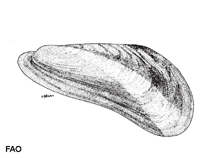
Shell rather small, thin and fragile, somewhat translucent, roughly elongate trapeziform in outline, with very long and rather narrow shape. Anterior margin of valves quite short and sharply rounded, clearly extending forwards beyond the umbones. Ventral margin very long and broadly concave medially. A broad and rounded keel, radiating obliquely towards posteroventral end of valves and bordered anteriorly by a wide and shallow depression determining the sinuation of ventral margin. Outer surface of valves smoothish with only fine concentric growth lines and a few small radial grooves in front of the umbones. Periostracum smooth and shiny, translucent, closely applied to shell surface. Hinge line with very small crenulations, mainly appearing behind the ligamental margin. Anterior adductor scar present. Internal margins very thin and smooth, undulate anteriorly in relation to the outer radial sculpture. Colour: outer coloration variable, light tan to olive-green or brown, often paler on the keel, with a median radial band and sometimes irregular transverse stripes of purplish brown on posterodorsal slope. Interior slightly pearly, pale bluish grey with the outer colour pattern showing through.
On soft bottoms, often occurring gregariously. Intertidal and shallow subtidal waters (Ref. 348).
Жизненный цикл и брачное поведение
половая зрелость | размножение | нерест | икра | Плодовитость | личинки
Members of the class Bivalvia are mostly gonochoric, some are protandric hermaphrodites. Life cycle: Embryos develop into free-swimming trocophore larvae, succeeded by the bivalve veliger, resembling a miniature clam.
Основная ссылка
ссылки | координатор | соавторы
Poutiers, J.M. 1998 Bivalves. Acephala, Lamellibranchia, Pelecypoda. p. 123-362. In Carpenter, K. E. and V. H. Niem. 1998. FAO species identification guide for fishery purposes. The living marine resources of the Western Central Pacific. Volume 1. Seaweeds, corals, bivalves, and gastropods. Rome, FAO. (ссылка 348)
Статус Красного Списка МСОП
(ссылка 130435: Version 2025-2 (Global))
Статус СИТЕС (ссылка 108899)
Not Evaluated
CMS (ссылка 116361)
Not Evaluated
Угроза для людей
Harmless
Использование человеком
FAO - Publication: search | FishSource |
инструменты
дополнительная информация
Трофическая экологияПищевые предметы (добыча)
состав пищи
потребление пищи
хищники
Динамика численности населения Жизненный циклразмножениеполовая зрелостьПлодовитостьнерестикраРазвитие икрыличинки ФизиологияПотребление кислорода
Связанные с человекомМарки, монеты и прочее.
Информационно-просветительская работа
ресурсы в Интернет
Оценки, основанные на моделях
устойчивость к внешним воздействиям
(Ref. 69278): |
высокий, минимальное время удвоения популяции до 15 месяцев (K=1.2; tmax=2) |
Уязвимость рыбной ловли
(ссылка 71543) |
Low vulnerability (10 of 100). |
Категория цены
(ссылка 80766): |
Medium. |