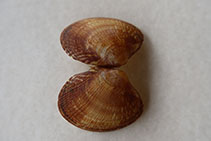
Bivalvia |
Venerida |
Veneridae
Môi trường: môi trường / vùng khí hậu / Mức độ sâu / phạm vi phân phối
Sinh thái học
Benthic; thuộc về nước lợ; pH range: 13.5 - 35.0; mức độ sâu 0 - 100 m (Tài liệu tham khảo 356). Tropical; ? - 35°C (Tài liệu tham khảo 104360), preferred 18°C (Tài liệu tham khảo 107945); 56°N - 11°S, 75°E - 164°E (Tài liệu tham khảo 348)
Indo-Pacific and the Mediterranean: from India and Sri Lanka to Micronesia; north to Sakhalin, the Japan Sea and Hawaii (introduced), and south to Indonesia. Introduced in the Northeast Atlantic.
Chiều dài lúc trưởng thành đầu tiên / Bộ gần gũi / Khối lượng (Trọng lượng) / Tuổi
Chín muồi sinh dục: Lm 2.7 range ? - ? cm Max length : 8.0 cm SHL con đực/không giới tính; (Tài liệu tham khảo 348); common length : 5.0 cm SHL con đực/không giới tính; (Tài liệu tham khảo 348); Tuổi cực đại được báo cáo: 14 các năm (Tài liệu tham khảo 104360)
Introduced incidentally with Japanese oysters (Crassostrea gigas), or for aquaculture trials, in many areas (Ref. 348). Found in littoral to sublittoral sediments (Ref. 1314). Intertidal and upper subtidal flats (Ref. 106937). Common in protected marine areas (Ref. 348). With short siphons and buries to only about 10 cm deep in a variety of substrates, from mud, sand, and gravel, high along intertidal areas (Refs. 95344, 104238). Occasionally overlaps with Zostera japonica beds or Zostera marina beds in the intertidal (Ref. 106937). Suspension feeder. Diet includes phytoplankton (Refs. 104238, 104360), benthic diatoms, and terrestrial organic matter (Ref. 104238).
Broadcast spawners. Life cycle: Embryos develop into free-swimming trocophore larvae, succeeded by the bivalve veliger (with ciliated vellum to assist mobility and feeding), resembling a miniature clam. After 2-4 weeks, it develops into a peliveliger with a formed foot to assist further with swimming, as well as byssal threads to help the clam secure itself onto the seafloor once it finds a suitable substrate to settle on. Burrowing into the ground allows the animal to find food and be protected from predators. Once settled, it will stay in the substrate and continue to grow into a mature clam.
SAUP Database 2006 SAUP Database. www.seaaroundus.org. (Tài liệu tham khảo 356)
Tình trạng Sách đỏ IUCN
(Tài liệu tham khảo 130435: Version 2025-2 (Global))
tình trạng CITES (Tài liệu tham khảo 108899)
Not Evaluated
CMS (Tài liệu tham khảo 116361)
Not Evaluated
Mối đe dọa đối với con người
Sử dụng của con người
Các nghề cá: tính thương mại
FAO - Aquaculture Systems: hồ sơ loài, production search; Các nghề cá: hồ sơ loài, landings search; Publication: search | FishSource | Biển chung quanh ta
Các công cụ
Thêm thông tin
Sinh lý họcThành phần ô-xy
Liên quan đến con ngườiTem, tiền xu, v.v.
Các nguồn internet
Ước tính dựa trên mô hình
Thích nghi nhanh
(Ref. 69278): |
Chiêù cao, thời gian nhân đôi của chủng quần tối thiểu là dưới 15 tháng (K=0.3-0.91; tm=1.5; tmax=14) |
Rate of population increase
|
Prior r = 1.19, 95% CL = 0.79 - 1.79, Based on 1 data-limited stock assessment. |
Sự dễ bị tổn thương của nghề đánh cá
(Tài liệu tham khảo 71543) |
Low to moderate vulnerability (31 of 100). |
Sự dễ bị tổn thương của khí hậu
(Tài liệu tham khảo 125649) |
High to very high vulnerability (71 of 100) |
Loại giá
(Tài liệu tham khảo 80766): |
Medium. |
Nutrients
|
Calcium = 149 [71, 228] mg/100g; Iron = 8.53 [1.95, 15.11] mg/100g; Protein = 9.88 [8.64, 11.12] %; Omega3 = 0.313 [0.202, 0.423] g/100g; Selenium = 61 [50, 72] μg/100g; VitaminA = 0 μg/100g; Zinc = 2.04 [0.56, 3.51] mg/100g (wet weight); based on nutrient studies. |