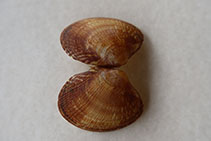
Bivalvia |
Venerida |
Veneridae
Entorno: milieu / zona climática / rango de profundidad / gama de distribución
Ecología
Benthic; salobre; pH range: 13.5 - 35.0; rango de profundidad 0 - 100 m (Referencia 356). Tropical; ? - 35°C (Referencia 104360), preferred 18°C (Referencia 107945); 56°N - 11°S, 75°E - 164°E (Referencia 348)
Indo-Pacific and the Mediterranean: from India and Sri Lanka to Micronesia; north to Sakhalin, the Japan Sea and Hawaii (introduced), and south to Indonesia. Introduced in the Northeast Atlantic.
Longitud en la primera madurez / Tamaño / Peso / Edad
Madurez: Lm 2.7 range ? - ? cm Max length : 8.0 cm SHL macho / no sexado; (Referencia 348); common length : 5.0 cm SHL macho / no sexado; (Referencia 348); edad máxima reportada: 14 años (Referencia 104360)
Introduced incidentally with Japanese oysters (Crassostrea gigas), or for aquaculture trials, in many areas (Ref. 348). Found in littoral to sublittoral sediments (Ref. 1314). Intertidal and upper subtidal flats (Ref. 106937). Common in protected marine areas (Ref. 348). With short siphons and buries to only about 10 cm deep in a variety of substrates, from mud, sand, and gravel, high along intertidal areas (Refs. 95344, 104238). Occasionally overlaps with Zostera japonica beds or Zostera marina beds in the intertidal (Ref. 106937). Suspension feeder. Diet includes phytoplankton (Refs. 104238, 104360), benthic diatoms, and terrestrial organic matter (Ref. 104238).
Broadcast spawners. Life cycle: Embryos develop into free-swimming trocophore larvae, succeeded by the bivalve veliger (with ciliated vellum to assist mobility and feeding), resembling a miniature clam. After 2-4 weeks, it develops into a peliveliger with a formed foot to assist further with swimming, as well as byssal threads to help the clam secure itself onto the seafloor once it finds a suitable substrate to settle on. Burrowing into the ground allows the animal to find food and be protected from predators. Once settled, it will stay in the substrate and continue to grow into a mature clam.
SAUP Database 2006 SAUP Database. www.seaaroundus.org. (Referencia 356)
Situación en la Lista Roja de la UICN
(Referencia 130435: Version 2025-2 (Global))
Estatus CITES (Referencia 108899)
Not Evaluated
CMS (Referencia 116361)
Not Evaluated
Amenaza para el ser humano
Usos humanos
Pesquerías: comercial
FAO - Aquaculture Systems: perfil de la especie, production search; pesquerías: perfil de la especie, landings search; Publication: search | FishSource | Sea Around Us
Herramientas
Más información
FisiologíaConsumo del oxígeno
Relacionados con el ser humanoSellos, monedas, varios
Fuentes de Internet
Estimaciones basadas en modelos
Resiliencia
(Ref. 69278): |
Alto, población duplicada en un tiempo mínimo inferior a 15 meses (K=0.3-0.91; tm=1.5; tmax=14) |
Rate of population increase
|
Prior r = 1.19, 95% CL = 0.79 - 1.79, Based on 1 data-limited stock assessment. |
Vulnerabilidad pesquera
(Referencia 71543) |
Low to moderate vulnerability (31 of 100). |
Vulnerabilidad climática
(Referencia 125649) |
High to very high vulnerability (71 of 100) |
Categoría de precios
(Referencia 80766): |
Medium. |
Nutrients
|
Calcium = 149 [71, 228] mg/100g; Iron = 8.53 [1.95, 15.11] mg/100g; Protein = 9.88 [8.64, 11.12] %; Omega3 = 0.313 [0.202, 0.423] g/100g; Selenium = 61 [50, 72] μg/100g; VitaminA = 0 μg/100g; Zinc = 2.04 [0.56, 3.51] mg/100g (wet weight); based on nutrient studies. |