Holothuroidea |
Holothuriida |
Holothuriidae
Môi trường: môi trường / vùng khí hậu / Mức độ sâu / phạm vi phân phối
Sinh thái học
Cùng sống ở rạn san hô; mức độ sâu 0 - 30 m (Tài liệu tham khảo 122). Tropical
Indo-Pacific, excluding the Persian Gulf and Hawaii.
Chiều dài lúc trưởng thành đầu tiên / Bộ gần gũi / Khối lượng (Trọng lượng) / Tuổi
Chín muồi sinh dục: Lm ? range ? - ? cm Max length : 45.0 cm TL con đực/không giới tính; (Tài liệu tham khảo 122); common length : 35.0 cm TL con đực/không giới tính; (Tài liệu tham khảo 122); Khối lượng cực đại được công bố: 1.3 kg (Tài liệu tham khảo 122)
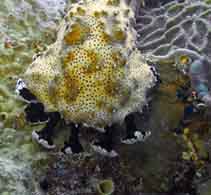
Mean live weight 700 to 1,300 g; body-wall thickness 0.4 cm. Body sub cylindrical, arched dorsally (bivium) and slightly flattened ventrally (trivium). White conical papillae sparsely distributed on bivium; podia on trivium long and large, their calcareous disc around 240 micrometer in diameter. Mouth ventral, surrounded by 25 large, black brown dots and numerous small black spots; trivium grey, also with small black spots. Spicules on dorsal and ventral tegument with pseudo-tables and rosettes; pseudo-tables consisting of large base with a large hole, and a spiny spire; rosettes numerous, those in the tegument simple, but more complicated in the dorsal papillae and ventral podia; also present around anus are rods, small plates, and tables with very spiny crown; tentacles containing a few rods and large plates derived from rosettes.
Maximum depth from Ref. 85218. Not harvested for bêche-de-mer production (Ref. 122). A coral reef species rarely found in depths of more than 25 m; mostly found on reef slopes close to the coast (Ref. 122, 85218); abundant on corals mixed with calcareous red algae. Population densities generally less than 0.005 per square meter (Ref. 122). In times of considerable irritation, this animal ejects Cuvierian tubules (Ref. 85218). Feeds on the surface of coral colonies and sponges (Ref. 101700).
Vòng đời và hành vi giao phối
Chín muồi sinh dục | Sự tái sinh sản | Đẻ trứng | Các trứng | Sự sinh sản | Ấu trùng
Members of the class Holothuroidea are gonochoric and have only one gonad. Spawning and fertilization are both external and some exhibit brooding. Life cycle: Embryos develop into planktotrophic larvae (auricularia) then into doliolaria (barrel-shaped stage) which later metamorphose into juvenile sea cucumbers.
Conand, C. 1998 Holothurians (sea cucumbers, Class Holothuroidea). p. 1157-1190. In Carpenter, K.E. and V.H. Niem (eds.) FAO Species Identification Guide for Fishery Purposes. The Living Marine Resources of the Western Central Pacific. Vol. 2. Cephalopods, crustaceans, holothurians and sharks. FAO Rome. (Tài liệu tham khảo 122)
Tình trạng Sách đỏ IUCN
(Tài liệu tham khảo 130435: Version 2025-2 (Global))
tình trạng CITES (Tài liệu tham khảo 108899)
Not Evaluated
CMS (Tài liệu tham khảo 116361)
Not Evaluated
Mối đe dọa đối với con người
Harmless
Sử dụng của con người
Các nghề cá: không ích lợi (thú vị)
FAO - Publication: search | FishSource |
Các công cụ
Thêm thông tin
Vòng đờiSự tái sinh sảnChín muồi sinh dụcSự sinh sảnĐẻ trứngCác trứngSự phát triển của trứngẤu trùng Sinh lý họcThành phần ô-xy
Liên quan đến con ngườiTem, tiền xu, v.v.
Các nguồn internet
Ước tính dựa trên mô hình
Thích nghi nhanh
(Ref. 69278): |
Trung bình, thời gian nhân đôi của chủng quần tối thiểu là 1.4 - 4.4 năm (K=0.17) |
Sự dễ bị tổn thương của nghề đánh cá
(Tài liệu tham khảo 71543) |
Moderate vulnerability (39 of 100). |
Loại giá
(Tài liệu tham khảo 80766): |
Unknown. |