Holothuroidea |
Holothuriida |
Holothuriidae
สิ่งแวดล้อม : สิ่งแวดล้อม / เขตภูมิอากาศ / ระดับความลึก / ระยะการกระจายสินค้า
นิเวศวิทยา
เกี่ยวกับหินโสโครก; ระดับความลึก 0 - 30 m (อ้างอิง 122). Tropical
Indo-Pacific, excluding the Persian Gulf and Hawaii.
ความยาวเมื่อครบกำหนดครั้งแรก / ขนาด / น้ำหนัก / อายุ
วัยเจริญพันธุ์: Lm ? range ? - ? cm Max length : 45.0 cm TL เพศผู้/กระเทย; (อ้างอิง 122); common length : 35.0 cm TL เพศผู้/กระเทย; (อ้างอิง 122); น้ำหนักสูงสุดที่มีการรายงาน: 1.3 kg (อ้างอิง 122)
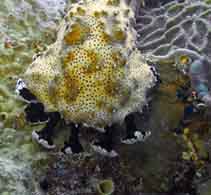
Mean live weight 700 to 1,300 g; body-wall thickness 0.4 cm. Body sub cylindrical, arched dorsally (bivium) and slightly flattened ventrally (trivium). White conical papillae sparsely distributed on bivium; podia on trivium long and large, their calcareous disc around 240 micrometer in diameter. Mouth ventral, surrounded by 25 large, black brown dots and numerous small black spots; trivium grey, also with small black spots. Spicules on dorsal and ventral tegument with pseudo-tables and rosettes; pseudo-tables consisting of large base with a large hole, and a spiny spire; rosettes numerous, those in the tegument simple, but more complicated in the dorsal papillae and ventral podia; also present around anus are rods, small plates, and tables with very spiny crown; tentacles containing a few rods and large plates derived from rosettes.
Maximum depth from Ref. 85218. Not harvested for bêche-de-mer production (Ref. 122). A coral reef species rarely found in depths of more than 25 m; mostly found on reef slopes close to the coast (Ref. 122, 85218); abundant on corals mixed with calcareous red algae. Population densities generally less than 0.005 per square meter (Ref. 122). In times of considerable irritation, this animal ejects Cuvierian tubules (Ref. 85218). Feeds on the surface of coral colonies and sponges (Ref. 101700).
วงจรชีวิตและพฤติกรรมการผสมพันธุ์
วัยเจริญพันธุ์ | การสืบพันธุ์ | การวางไข่ | เซลสืบพันธ์ของเพศเมีย(ไข่) | ความดกของไข่ | ตัวอ่อน
Members of the class Holothuroidea are gonochoric and have only one gonad. Spawning and fertilization are both external and some exhibit brooding. Life cycle: Embryos develop into planktotrophic larvae (auricularia) then into doliolaria (barrel-shaped stage) which later metamorphose into juvenile sea cucumbers.
Conand, C. 1998 Holothurians (sea cucumbers, Class Holothuroidea). p. 1157-1190. In Carpenter, K.E. and V.H. Niem (eds.) FAO Species Identification Guide for Fishery Purposes. The Living Marine Resources of the Western Central Pacific. Vol. 2. Cephalopods, crustaceans, holothurians and sharks. FAO Rome. (อ้างอิง 122)
สถานะบัญชีแดงของ IUCN
(อ้างอิง 130435: Version 2025-2 (Global))
สถานะไซเตส (อ้างอิง 108899)
Not Evaluated
CMS (อ้างอิง 116361)
Not Evaluated
ภัยคุกคามต่อมนุษย์
Harmless
การใช้ของมนุษย์
การประมง: ไม่มีผลประโยชน์
FAO - Publication: search | FishSource |
เครื่องมือ
ข้อมูลเพิ่มเติม
วงจรชีวิตการสืบพันธุ์วัยเจริญพันธุ์ความดกของไข่การวางไข่เซลสืบพันธ์ของเพศเมีย(ไข่)การพัฒนาไข่ตัวอ่อน เกี่ยวข้องกับมนุษย์แสตมป์ เหรียญ อื่นๆ
แหล่งที่มาจากอินเตอร์เน็ต
การประมาณค่าตามแบบจำลอง
ความสามารถในการกลับคืนสู่ปกติ
(Ref. 69278): |
ขนาดกลาง, เวลาต่ำสุดที่จะทำให้ประชากรเพิ่มขึ้นเป็น 2 เท่าใช้เวลา 1.4 - 4.4 ปี (K=0.17) |
ความเสี่ยงต่อการตกปลา
(อ้างอิง 71543) |
Moderate vulnerability (39 of 100). |
หมวดหมู่ราคา
(อ้างอิง 80766): |
Unknown. |