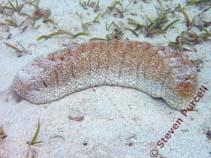
Holothuroidea |
Holothuriida |
Holothuriidae
Meio ambiente: milieu / Zona climática / intervalo de profundidade / faixa de distribuição
Ecologia
Associadas(os) a recifes; intervalo de profundidade 0 - 25 m (Ref. 122). Tropical; 31°N - 32°S, 32°E - 173°W
Indo-Pacific: in the tropical Indian Ocean known only from Madagascar; in the tropical Pacific, in the west from Australia and Sulawesi eastwards to Mariana Islands, Palau and New Caledonia.
Comprimento de primeira maturação / Tamanho / Peso / Idade
Maturidade: Lm ?, range 35 - ? cm Max length : 70.0 cm TL macho/indeterminado; (Ref. 122); common length : 36.0 cm TL macho/indeterminado; (Ref. 122); peso máx. publicado: 4.5 kg (Ref. 122)
Mean live weight. 1500 to 4,500 g; body-wall thickness 1 cm. Body sub oval, stout, firma and rigid, arched dorsally (bivium) and flattened ventrally (trivium); bivium with characteristic brown wrinkles. Podia on bivium small, brown, with a disc of around 200 micrometer diameter; podia on trivium more densely distributed on the median radius and more sparsely distributed on the outer radii and interradii, with their calcareous disc around 300 micrometer in diameter. Mouth ventral, with 20 brown, stout tentacles. Anus surrounded by 5 radial groups of 3 or 4 papillae and a black band. Calcareous ring with large radial pieces and narrower interradials. Cuvierian tubules absent. Cloaca large and black. Bivium golden brown, with numerous brown spots; trivium whitish; mature gonads bright yellow. Spicules in form of tables and buttons; tables of dorsal and ventral tegument similar in shape and moderately sparse, disc small, irregular, with 4 to 6 irregular holes, supporting a short spire, ending in an irregular row of smooth spines; ventral-tegument buttons elongated ellipsoids, with 12 to 16 holes and median nodules; dorsal-tegument buttons generally more regular and less perforated; ventral and dorsal podia with large plates, multiperforated and indentated; tentacles containing both large very spiny rods and short nodose rods.
Occasionally harvested by artisanal fisheries throughout the tropical Indian Ocean; collected by skin diving or using diving gear (if not banned), making the populations very vulnerable, due to over exploitation. The processed product is of minor commercial value. Commonly found in reef slopes and lagoons, also seen in shallow seagrass beds; mostly in depths of less than 25 m (Ref. 122). Generally found on coarse sand or coral rubble (Ref. 92930). Population densities around 0.005 per square meter. Grazes on organic material (Ref. 800).
Sexual reproduction takes place during the warm season. A species with low potential fecundity and late sexual maturity.
Conand, C. 1998 Holothurians (sea cucumbers, Class Holothuroidea). p. 1157-1190. In Carpenter, K.E. and V.H. Niem (eds.) FAO Species Identification Guide for Fishery Purposes. The Living Marine Resources of the Western Central Pacific. Vol. 2. Cephalopods, crustaceans, holothurians and sharks. FAO Rome. (Ref. 122)
Status na Lista Vermelha da UICN
(Ref. 130435: Version 2025-2 (Global))
Status no CITES (Ref. 108899)
Not Evaluated
Not Evaluated
Ameaça para os humanos
Harmless
Uso pelos humanos
Pescarias: pouco comercial
FAO - Publication: search | FishSource |
Ferramentas
Mais informação
Ecologia TróficaItens alimentares (presas)
Composição da dieta
Consumo alimentar
Predadores
FisiologiaConsumo de oxigênio
Relacionado a humanosSelos, moedas, diversos.
Fontes da internet
Estimativas baseadas em modelos
Vulnerabilidade da pesca
(Ref. 71543) |
High to very high vulnerability (65 of 100). |
Categoria de preço
(Ref. 80766): |
Unknown. |