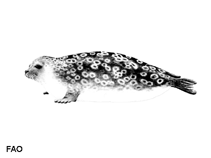
Mammalia |
Carnivora |
Phocidae
Entorno: milieu / zona climática / rango de profundidad / gama de distribución
Ecología
Batidemersal. Polar; 90°N - 0°S, 180°W - 180°E
Northeast Atlantic, Atlantic Ocean, Pacific Ocean and the Arctic: Svalbard, Hudson Bay and Strait (Canada), Bering and Baltic Seas (Ref. 1394). Pusa hispida hispida: Arctic Ocean, Bering Sea, North Pole, James Bay and Baffin Island (Nunavut), Strait of Belle Isle (Newfoundland), Greenland, Barents Sea, Norway, White Sea, Kamchatka, Bristol Bay in Alaska, and vagrant to Azores, Germany, Portugal, New Jersey, Southern California; Pusa hispida botnica: Baltic Sea, Gulf of Bothnia and Finland, Sweden, Latvia; Pusa hispida ladogensis: Russia, Gulf of Finland, Lake Ladoga, White Sea; Pusa hispida saimensis: Finland; Pusa hispida ochotensis: Sea of Okhotsk, Japan, Russia, Kamchatka, and vagrant to Jiangsu, China (Ref. 1522). Climate: Circumpolar, subtropical, boreal.
Longitud en la primera madurez / Tamaño / Peso / Edad
Madurez: Lm ? range ? - ? cm Max length : 165 cm TL macho / no sexado; (Referencia 1394); peso máximo publicado: 110.0 kg (Referencia 1394)
Feeds on fishes and planktonic crustaceans (Ref. 1394). Incidental injuries and death of this species are caused by commercial fishing gears, i.e., flatfish trawl, pollock trawl, cod trawl, and cod longline (Ref. 118427). Typically stays in ice-covered waters year-round (Ref. 117965). Feeds on fishes (Ref. 1394) and planktonic crustaceans like pelagic amphipods and mysids (Ref. 117965).
Ciclo vital y comportamiento de apareamiento
Madurez | Reproducción | Puesta | Huevos | Fecundidad | Larva
Jefferson, T.A., S. Leatherwood and M.A. Webber 1993 FAO species Identification Guide: Marine Mammals of the World. Rome, FAO. 320 p. + 587 figures. (Referencia 1394)
Situación en la Lista Roja de la UICN
(Referencia 130435: Version 2025-2 (Global))
Estatus CITES (Referencia 108899)
Not Evaluated
CMS (Referencia 116361)
Not Evaluated
Amenaza para el ser humano
Usos humanos
Pesquerías: comercial
FAO - pesquerías: perfil de la especie, landings search; Publication: search | FishSource | Sea Around Us
Herramientas
Más información
Ciclo de vidaReproducciónMadurezFecundidadPuestaHuevosDesarrollo de los huevosLarva FisiologíaConsumo del oxígeno
Relacionados con el ser humanoSellos, monedas, varios
Fuentes de Internet
Estimaciones basadas en modelos
Resiliencia
(Ref. 69278): |
Medio, población duplicada en un tiempo mínimo de 1.4-4.4 años (K=0.08-0.43) |
Vulnerabilidad pesquera
(Referencia 71543) |
High to very high vulnerability (75 of 100). |
Categoría de precios
(Referencia 80766): |
Unknown. |