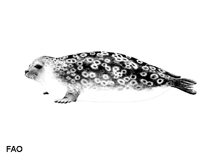
Mammalia |
Carnivora |
Phocidae
Environnement : milieu / zone climatique / profondeur / gamme de distribution
Écologie
Bathydémersal. Polar; 90°N - 0°S, 180°W - 180°E
Northeast Atlantic, Atlantic Ocean, Pacific Ocean and the Arctic: Svalbard, Hudson Bay and Strait (Canada), Bering and Baltic Seas (Ref. 1394). Pusa hispida hispida: Arctic Ocean, Bering Sea, North Pole, James Bay and Baffin Island (Nunavut), Strait of Belle Isle (Newfoundland), Greenland, Barents Sea, Norway, White Sea, Kamchatka, Bristol Bay in Alaska, and vagrant to Azores, Germany, Portugal, New Jersey, Southern California; Pusa hispida botnica: Baltic Sea, Gulf of Bothnia and Finland, Sweden, Latvia; Pusa hispida ladogensis: Russia, Gulf of Finland, Lake Ladoga, White Sea; Pusa hispida saimensis: Finland; Pusa hispida ochotensis: Sea of Okhotsk, Japan, Russia, Kamchatka, and vagrant to Jiangsu, China (Ref. 1522). Climate: Circumpolar, subtropical, boreal.
Longueur à la première maturité / Taille / Poids / Âge
Maturité: Lm ? range ? - ? cm Max length : 165 cm TL mâle / non sexé; (Réf. 1394); poids max. publié: 110.0 kg (Réf. 1394)
Feeds on fishes and planktonic crustaceans (Ref. 1394). Incidental injuries and death of this species are caused by commercial fishing gears, i.e., flatfish trawl, pollock trawl, cod trawl, and cod longline (Ref. 118427). Typically stays in ice-covered waters year-round (Ref. 117965). Feeds on fishes (Ref. 1394) and planktonic crustaceans like pelagic amphipods and mysids (Ref. 117965).
Cycle de vie et comportement reproducteur
Maturité | Reproduction | Frai | Œufs | Fécondité | Larves
Jefferson, T.A., S. Leatherwood and M.A. Webber 1993 FAO species Identification Guide: Marine Mammals of the World. Rome, FAO. 320 p. + 587 figures. (Réf. 1394)
Statut dans la liste rouge de l'IUCN
(Réf. 130435: Version 2025-2 (Global))
statut CITES (Réf. 108899)
Not Evaluated
Not Evaluated
Menace pour l'homme
Utilisations par l'homme
Pêcheries: commercial
FAO - pêcheries: Résumé espèce, landings search; Publication: search | FishSource | Sea Around Us
Outils
Plus d'informations
Dynamique des populations Cycle de vieReproductionMaturitéFéconditéFraiŒufsDéveloppement de l'œufLarves PhysiologieConsommation d'oxygène
Liées à l'hommeTimbres, pièces de monnaie, divers
Sources Internet
Estimations basées sur des modèles
Résilience
(Ref. 69278): |
Milieu, temps minimum de doublement de population : 1,4 à 4,4 années (K=0.08-0.43) |
Vulnérabilité de la pêche
(Réf. 71543) |
High to very high vulnerability (75 of 100). |
Catégorie de prix
(Réf. 80766): |
Unknown. |