Mammalia |
Carnivora |
Phocidae
Umwelt: Milieu / Klimazone / Tiefenbereich / Verbreitungsgebiet
Ökologie
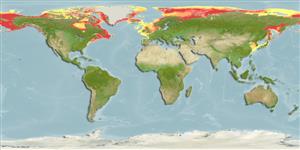
Bathydemersal. Temperate; 90°N - 0°S, 180°W - 180°E
Pacific Northwest, Pacific Ocean, Atlantic Ocean and the Arctic: Bering Sea, Sea of Okhotsk, Atlantic Ocean, Canada Quebec, Alaska, Greenland, Canada Newfoundland, Norway, Russia, Japan (Ref. 1394), Canada, Iceland, UK, France, Spain, Portugal, China, Kamchatka, Laptev Sea (Ref. 1522); Erignathus barbatus barbatus: Canada, Greenland, Russia, Canada Newfoundland, Iceland, Norway, UK, France, Spain, Portugal; Erignathus barbatus nauticus: Russia, Canada, Laptev Sea, Alaska, Japan, China, Sea of Okhotsk, Kamchatka.
Länge bei der ersten Reifung / Größe / Gewicht / Alter
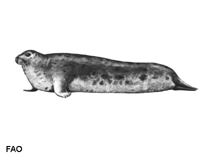
Geschlechtsreife: Lm ? range ? - ? cm Max length : 250 cm TL Männchen/unbestimmt; (Ref. 1394)
They usually restrict themselves to sea ice and stay in relatively shallow areas of continuously moving ice, where open leads and polynyas regularly form. In some areas, they are known to haul out on shore, ascend streams, or live a pelagic existence away from ice and land for long periods of time. Feeds on many species of small invertebrates that live on, and in, the bottom; and fish (Ref. 1394). They usually restrict themselves to sea ice and stay in relatively shallow areas of continuously moving ice, where open leads and polynyas regularly form. In some areas, they are known to haul out on shore, ascend streams, or live a pelagic existence away from ice and land for long periods of time. Feeds on many species of small invertebrates that live on, and in, the bottom; fish (Ref. 1394).
Lebenszyklus und Paarungsverhalten
Geschlechtsreife | Fortpflanzung | Ablaichen | Eier | Fruchtbarkeit | Larven
Jefferson, T.A., S. Leatherwood and M.A. Webber 1993 FAO species Identification Guide: Marine Mammals of the World. Rome, FAO. 320 p. + 587 figures. (Ref. 1394)
IUCN Rote Liste Status
(Ref. 130435: Version 2025-2 (Global))
CITES Status (Ref. 108899)
Not Evaluated
Not Evaluated
Bedrohung für Menschen
Nutzung durch Menschen
Fischereien: kommerziell
FAO - Fischereien: Artbeschreibung, landings search; Publication: search | FishSource | Das Meer um uns herum
Tools
Mehr Information
LebenszyklusFortpflanzungGeschlechtsreifeFruchtbarkeitAblaichenEierEientwicklungLarven PhysiologieSauerstoffverbrauch
MenschenbezogenBriefmarken, Münzen, Verschiedenes.
Internet Quellen
Schätzungen auf der Grundlage von Modellen
Widerstandsfähigkeit
(Ref. 69278): |
mittel, Verdopplung der Population dauert 1,4 - 4,4 Jahre. (K=0.18-0.29) |
Anfälligkeit der Fischerei
(Ref. 71543) |
High to very high vulnerability (74 of 100). |
Preiskategorie
(Ref. 80766): |
Unknown. |