Mammalia |
Carnivora |
Phocidae
Milieu: milieu / Klimaatzone / Diepte / verspreidingsgebied
Ecologie
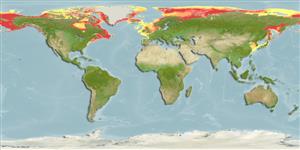
Bathydemersaal. Temperate; 90°N - 0°S, 180°W - 180°E
Pacific Northwest, Pacific Ocean, Atlantic Ocean and the Arctic: Bering Sea, Sea of Okhotsk, Atlantic Ocean, Canada Quebec, Alaska, Greenland, Canada Newfoundland, Norway, Russia, Japan (Ref. 1394), Canada, Iceland, UK, France, Spain, Portugal, China, Kamchatka, Laptev Sea (Ref. 1522); Erignathus barbatus barbatus: Canada, Greenland, Russia, Canada Newfoundland, Iceland, Norway, UK, France, Spain, Portugal; Erignathus barbatus nauticus: Russia, Canada, Laptev Sea, Alaska, Japan, China, Sea of Okhotsk, Kamchatka.
Lengte bij maturiteit / Grootte / Gewicht / Leeftijd
Maturiteit: Lm ? range ? - ? cm Max length : 250 cm TL mannelijk / geslacht onbekend; (Ref. 1394)
They usually restrict themselves to sea ice and stay in relatively shallow areas of continuously moving ice, where open leads and polynyas regularly form. In some areas, they are known to haul out on shore, ascend streams, or live a pelagic existence away from ice and land for long periods of time. Feeds on many species of small invertebrates that live on, and in, the bottom; and fish (Ref. 1394). They usually restrict themselves to sea ice and stay in relatively shallow areas of continuously moving ice, where open leads and polynyas regularly form. In some areas, they are known to haul out on shore, ascend streams, or live a pelagic existence away from ice and land for long periods of time. Feeds on many species of small invertebrates that live on, and in, the bottom; fish (Ref. 1394).
Levenscyclus en paargedrag
Maturiteit | Voortplanting | Paaien | Eieren | Fecunditeit | Larven
Jefferson, T.A., S. Leatherwood and M.A. Webber 1993 FAO species Identification Guide: Marine Mammals of the World. Rome, FAO. 320 p. + 587 figures. (Ref. 1394)
Status op de Rode Lijst van het IUCN
(Ref. 130435: Version 2025-2 (Global))
CITES status (Ref. 108899)
Not Evaluated
Not Evaluated
Gevaar voor de mens
Gebruik door de mens
Visserij: commercieel
FAO - visserij: soortsprofiel, landings search; Publication: search | FishSource | Sea Around Us
Tools
Meer informatie
LevenscyclusVoortplantingMaturiteitFecunditeitPaaienEierenOntwikkeling van de eierenLarven FysiologieZuurstofverbruik
Menselijk gerelateerdPostzegels, munten, diversen.
Internetbronnen
Schattingen op basis van modellen
Weerstandsvermogen
(Ref. 69278): |
Gemiddeld, minimale populatieverdubbelingstijd 1,4-4,4 jaar (K=0.18-0.29) |
Kwetsbaarheid van de visserij
(Ref. 71543) |
High to very high vulnerability (74 of 100). |
Prijsklasse
(Ref. 80766): |
Unknown. |