Mammalia |
Carnivora |
Phocidae
Environnement : milieu / zone climatique / profondeur / gamme de distribution
Écologie
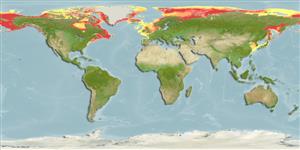
Bathydémersal. Temperate; 90°N - 0°S, 180°W - 180°E
Pacific Northwest, Pacific Ocean, Atlantic Ocean and the Arctic: Bering Sea, Sea of Okhotsk, Atlantic Ocean, Canada Quebec, Alaska, Greenland, Canada Newfoundland, Norway, Russia, Japan (Ref. 1394), Canada, Iceland, UK, France, Spain, Portugal, China, Kamchatka, Laptev Sea (Ref. 1522); Erignathus barbatus barbatus: Canada, Greenland, Russia, Canada Newfoundland, Iceland, Norway, UK, France, Spain, Portugal; Erignathus barbatus nauticus: Russia, Canada, Laptev Sea, Alaska, Japan, China, Sea of Okhotsk, Kamchatka.
Longueur à la première maturité / Taille / Poids / Âge
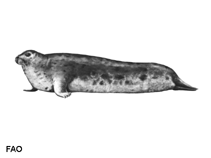
Maturité: Lm ? range ? - ? cm Max length : 250 cm TL mâle / non sexé; (Réf. 1394)
They usually restrict themselves to sea ice and stay in relatively shallow areas of continuously moving ice, where open leads and polynyas regularly form. In some areas, they are known to haul out on shore, ascend streams, or live a pelagic existence away from ice and land for long periods of time. Feeds on many species of small invertebrates that live on, and in, the bottom; and fish (Ref. 1394). They usually restrict themselves to sea ice and stay in relatively shallow areas of continuously moving ice, where open leads and polynyas regularly form. In some areas, they are known to haul out on shore, ascend streams, or live a pelagic existence away from ice and land for long periods of time. Feeds on many species of small invertebrates that live on, and in, the bottom; fish (Ref. 1394).
Cycle de vie et comportement reproducteur
Maturité | Reproduction | Frai | Œufs | Fécondité | Larves
Jefferson, T.A., S. Leatherwood and M.A. Webber 1993 FAO species Identification Guide: Marine Mammals of the World. Rome, FAO. 320 p. + 587 figures. (Réf. 1394)
Statut dans la liste rouge de l'IUCN
(Réf. 130435: Version 2025-2 (Global))
statut CITES (Réf. 108899)
Not Evaluated
Not Evaluated
Menace pour l'homme
Utilisations par l'homme
Pêcheries: commercial
FAO - pêcheries: Résumé espèce, landings search; Publication: search | FishSource | Sea Around Us
Outils
Plus d'informations
Dynamique des populations Cycle de vieReproductionMaturitéFéconditéFraiŒufsDéveloppement de l'œufLarves PhysiologieConsommation d'oxygène
Liées à l'hommeTimbres, pièces de monnaie, divers
Sources Internet
Estimations basées sur des modèles
Résilience
(Ref. 69278): |
Milieu, temps minimum de doublement de population : 1,4 à 4,4 années (K=0.18-0.29) |
Vulnérabilité de la pêche
(Réf. 71543) |
High to very high vulnerability (74 of 100). |
Catégorie de prix
(Réf. 80766): |
Unknown. |