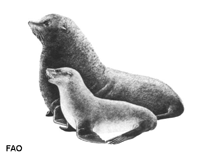
Mammalia |
Carnivora |
Otariidae
पर्यावरण: पर्यावरण / जलवायु क्षेत्र / गहराई सीमा / वितरण सीमा
पारिस्थितिकी
बाथीड़िमरसल. Subtropical; 0°N - 90°S, 180°W - 180°E
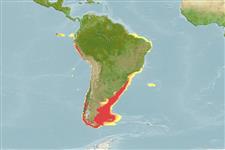
Eastern Pacific and Southwest Atlantic: Arctocephalus australis gracilis: Peru, southern Brazil, Uruguay, Argentina, Chile (Ref. 1394, 1522); vagrant to Colombia and Juan Fernandez Islands (Ref. 1522); Arctocephalus australis australis: Falkland Islands (Ref. 1522). Tropical to temperate climates.
प्रथम परिपक्वता पर लंबाई / आकार / वज़न / आयु
परिपक्व अवधि: Lm ? range ? - ? cm Max length : 190 cm TL पुल्लिंग / अलिंग; (संदर्भ 1394); 140 cm TL (female); अधिकतम प्रकाशित वज़न: 200.0 kg (संदर्भ 1394); अधिकतम प्रकाशित वज़न: 200.0 kg
Inhabits primarily coastal, continental shelf and slope waters; and there are records from more than 600 km offshore. Feeds on small schooling fish and invertebrates such as cephalopods, crustaceans and gastropods. Found primarily coastal, continental shelf and slope waters; there are records from more than 600 km offshore. Feeds on small schooling fish and invertebrates such as cephalopods, crustaceans and gastropods (Ref. 1394).
जीवन चक्र और संभोग व्यवहार
परिपक्व अवधि | पुनरुत्पत्ति | मछलीऔ का अंडे देना | अंडे | उपजाऊपन | लार्वा
Pups are born in dense breeding colonies. Perinatal attendance averages one week, then mothers forage offshore several days at a time. Upon arrival from sea, mother and pup reunites using vocalization signals and olfactory cues, i.e., naso-nasal contact. Lactation lasts at least 12 months.
Jefferson, T.A., S. Leatherwood and M.A. Webber 1993 FAO species Identification Guide: Marine Mammals of the World. Rome, FAO. 320 p. + 587 figures. (संदर्भ 1394)
आईयूसीएन रेड लिस्ट स्थिति
(संदर्भ 130435: Version 2025-2 (Global))
CITES स्थिति (संदर्भ 108899)
CMS (संदर्भ 116361)
मनुष्यों के लिए ख़तरा
मानव उपयोग
मात्स्यिकी: व्यापारिक
FAO - मात्स्यिकी: प्रजातियों की प्रोफ़ाइल, landings search; Publication: search | FishSource | हमारे चारों ओर समुद्र
साधन
अधिक जानकारी
जीवन चक्रपुनरुत्पत्तिपरिपक्व अवधिउपजाऊपनमछलीऔ का अंडे देनाअंडेअंडे का विकासलार्वा फिजियोलॉजीप्राणवायु की खपत
मानव संबंधीटिकट, सिक्के, विविध.
इंटरनेट स्रोत
मॉडल पर आधारित अनुमान
लौटाव
(Ref. 69278): |
माध्यम, न्यूनतम जनसंख्या दुगनी होने का समय 1.4 - 4.4 वर्ष। (K=0.3) |
मछली पकड़ने की भेद्यता
(संदर्भ 71543) |
High to very high vulnerability (72 of 100). |
मूल्य श्रेणी
(संदर्भ 80766): |
Unknown. |