Mammalia |
Carnivora |
Otariidae
Lingkungan: lingkungan / zona iklim / kisaran kedalaman / jangkauan distribusi
Ekologi
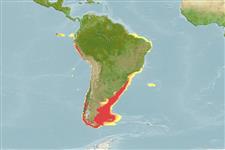
Batidemersal. Subtropical; 0°N - 90°S, 180°W - 180°E
Eastern Pacific and Southwest Atlantic: Arctocephalus australis gracilis: Peru, southern Brazil, Uruguay, Argentina, Chile (Ref. 1394, 1522); vagrant to Colombia and Juan Fernandez Islands (Ref. 1522); Arctocephalus australis australis: Falkland Islands (Ref. 1522). Tropical to temperate climates.
Panjang pada saat jatuh tempo pertama / Ukuran / Berat / umur
Kematangan: Lm ? range ? - ? cm Max length : 190 cm TL jantan/; (Acuan 1394); 140 cm TL (female); Berat maksimum terpublikasi: 200.0 kg (Acuan 1394); Berat maksimum terpublikasi: 200.0 kg
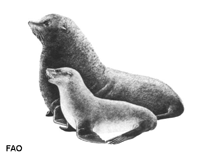
Inhabits primarily coastal, continental shelf and slope waters; and there are records from more than 600 km offshore. Feeds on small schooling fish and invertebrates such as cephalopods, crustaceans and gastropods. Found primarily coastal, continental shelf and slope waters; there are records from more than 600 km offshore. Feeds on small schooling fish and invertebrates such as cephalopods, crustaceans and gastropods (Ref. 1394).
Siklus hidup dan perilaku kawin
Kematangan | Reproduksi, perkembang biakan | Pemijahan | telur-telur | Fekunditas | Larva
Pups are born in dense breeding colonies. Perinatal attendance averages one week, then mothers forage offshore several days at a time. Upon arrival from sea, mother and pup reunites using vocalization signals and olfactory cues, i.e., naso-nasal contact. Lactation lasts at least 12 months.
rujukan utama
Acuan | Koordinator | mitra
Jefferson, T.A., S. Leatherwood and M.A. Webber 1993 FAO species Identification Guide: Marine Mammals of the World. Rome, FAO. 320 p. + 587 figures. (Acuan 1394)
Status IUCN Red List
(Acuan 130435: Version 2025-2 (Global))
status CITES (Acuan 108899)
ancaman kepada manusia
penggunaan manusia
Perikanan: komersial
FAO - Perikanan: profail spesis, landings search; Publication: search | FishSource | Laut di Sekitar Kita
Alat, peralatan
informasi lanjut
FisiologiKonsumsi oksigen
Yang berhubungan dengan manusiaPerangko, koin, dll.
Sumber internet
Estimasi berdasarkan model
Daya lenting
(Ref. 69278): |
sedang, Waktu penggandaan populasi minimum 1.4 - 4.4 tahun (K=0.3) |
Kerentanan Penangkapan Ikan
(Acuan 71543) |
High to very high vulnerability (72 of 100). |
kategori harga
(Acuan 80766): |
Unknown. |