Mammalia |
Cetartiodactyla |
Physeteridae
Meio ambiente: milieu / Zona climática / intervalo de profundidade / faixa de distribuição
Ecologia
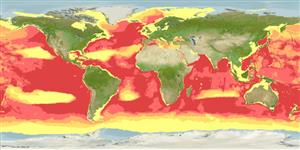
Pelágico(a,os,as); oceanódromo (Ref. 75906); intervalo de profundidade 0 - 3200 m (Ref. 1005), usually 500 - 500 m (Ref. 75906). Tropical; 90°N - 90°S, 180°W - 180°E
Circumglobal.
Comprimento de primeira maturação / Tamanho / Peso / Idade
Maturidade: Lm ?, range 830 - 920 cm Max length : 2,400 cm TL macho/indeterminado; (Ref. 99323); 1200 cm TL (female); peso máx. publicado: 57.0 t (Ref. 1394)
Largest sperm whale (Ref. 1394). Sperm whaling has a long history. The most intense periods were the Yankee whaling era of the 1800s and the factory ship whaling of the 20th century. Recent findings of studies on social behavior and breeding undermine assumptions in the models on which exploitation and management have long been based. Certain populations have been depleted, but the sperm whale remains the most abundant of all the great whales (Great whales generally include the sperm whale and all baleen whales, except the pygmy right whale) (Ref. 1394). Maximum size of female species based from Ref. 1394. Deep divers. Feeds on squids, octopuses (Ref. 1394), sharks, demersal rays, and bony fishes (Ref. 122680). Forms strong social bonds (Ref. 122680). Feeding strategy involves synchronized, individual hunting for non-schooling prey such as deep-sea squids (Ref. 130961).
Ciclo de vida ou comportamento de acasalamento
Maturidade | Reprodução | Desova | Ovos | Fecundidade | Larvas
Mature females live in socially cohesive groups of 10-30 individuals which include immature males and females and within is a communal suckling and caring of the young. Also, males leave the group at the age of 6 (Ref. 97765).
Jefferson, T.A., S. Leatherwood and M.A. Webber 1993 FAO species Identification Guide: Marine Mammals of the World. Rome, FAO. 320 p. + 587 figures. (Ref. 1394)
Status na Lista Vermelha da UICN
(Ref. 130435: Version 2025-2 (Global))
Status no CITES (Ref. 108899)
Ameaça para os humanos
Uso pelos humanos
Pescarias: espécies comerciais
FAO - pescarias: perfil da espécie, landings search; Publication: search | FishSource | Sea Around Us
Ferramentas
Mais informação
FisiologiaConsumo de oxigênio
Relacionado a humanosSelos, moedas, diversos.
Fontes da internet
Estimativas baseadas em modelos
Resiliência
(Ref. 69278): |
Baixo, tempo mínimo de duplicação da população 4,5 - 14 anos (K=0.05-0.16; tm=10) |
Vulnerabilidade da pesca
(Ref. 71543) |
Very high vulnerability (83 of 100). |
Categoria de preço
(Ref. 80766): |
Unknown. |