Mammalia |
Cetartiodactyla |
Physeteridae
Environnement : milieu / zone climatique / profondeur / gamme de distribution
Écologie
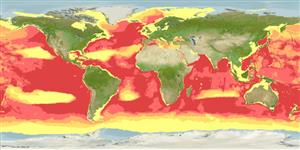
Pélagique; océanodrome (Réf. 75906); profondeur 0 - 3200 m (Réf. 1005), usually 500 - 500 m (Réf. 75906). Tropical; 90°N - 90°S, 180°W - 180°E
Circumglobal.
Longueur à la première maturité / Taille / Poids / Âge
Maturité: Lm ?, range 830 - 920 cm Max length : 2,400 cm TL mâle / non sexé; (Réf. 99323); 1200 cm TL (female); poids max. publié: 57.0 t (Réf. 1394)
Largest sperm whale (Ref. 1394). Sperm whaling has a long history. The most intense periods were the Yankee whaling era of the 1800s and the factory ship whaling of the 20th century. Recent findings of studies on social behavior and breeding undermine assumptions in the models on which exploitation and management have long been based. Certain populations have been depleted, but the sperm whale remains the most abundant of all the great whales (Great whales generally include the sperm whale and all baleen whales, except the pygmy right whale) (Ref. 1394). Maximum size of female species based from Ref. 1394. Deep divers. Feeds on squids, octopuses (Ref. 1394), sharks, demersal rays, and bony fishes (Ref. 122680). Forms strong social bonds (Ref. 122680). Feeding strategy involves synchronized, individual hunting for non-schooling prey such as deep-sea squids (Ref. 130961).
Cycle de vie et comportement reproducteur
Maturité | Reproduction | Frai | Œufs | Fécondité | Larves
Mature females live in socially cohesive groups of 10-30 individuals which include immature males and females and within is a communal suckling and caring of the young. Also, males leave the group at the age of 6 (Ref. 97765).
Jefferson, T.A., S. Leatherwood and M.A. Webber 1993 FAO species Identification Guide: Marine Mammals of the World. Rome, FAO. 320 p. + 587 figures. (Réf. 1394)
Statut dans la liste rouge de l'IUCN
(Réf. 130435: Version 2025-2 (Global))
statut CITES (Réf. 108899)
Menace pour l'homme
Utilisations par l'homme
Pêcheries: commercial
FAO - pêcheries: Résumé espèce, landings search; Publication: search | FishSource | Sea Around Us
Outils
Plus d'informations
Dynamique des populations PhysiologieConsommation d'oxygène
Liées à l'hommeTimbres, pièces de monnaie, divers
Sources Internet
Estimations basées sur des modèles
Résilience
(Ref. 69278): |
Faible, temps minimum de doublement de population : 4,5 à 14 années (K=0.05-0.16; tm=10) |
Vulnérabilité de la pêche
(Réf. 71543) |
Very high vulnerability (83 of 100). |
Catégorie de prix
(Réf. 80766): |
Unknown. |